PENETRANTE OU CASTRANTE?
UM NOME A CITAR A ACLAMAR ? PENETRAR POR PENETRAR?
É UM CASTIGO OU UM OLHAR NO UMBIGO?
É UM FEITO OU UM NOME A EITO
NOME PERFEITO OU SÓ UM SUJEITO À ESQUERDA DO DIREITO?
TENTAÇÕES DO APOCALIPSE? DOS 2% MATEMÁTICA ELIPSE ?
JUNTOS PHODEMOS FLUIDA FODA FÁCIL ?
VARIAÇÕES NUM ANÁTEMA GRÁCIL?
PHODER O PHODER EM FODA ARREPENDIDA?
O JUNTO PHODEMOS NESTE CONTEXTO-ENGANO EU ESGALHO OU ESGANO?
JUNTO PHODEMOS NO VULGAR DA VULGATA VULVAR?
dijous, 11 de desembre del 2014
JUNTOS PHODEMOS É NECESSÁRIO DIRIA MESMO É ...FUNDAMENTAL PHODEIS ROUBAR-NOS TUDO .....SOMOS UM POVO MUDO....OS BPN'S AS PPP'S OS BES E OS BEST'S E ATÉ AS BESTAS E TAMBÉM OS CARJAQUIN'S OS AFORISMOS AS ONAMATOPEIAS SEM PEIAS....PHODEIS LIMPAR-NOS AS HIPÉRBOLES AS METÁFORAS AS SUBTILEZAS DO LINGUAJAR DOS BURGUESES E BURGESSOS PHODEIS PENETRAR NAS URNAS PATÉTICAS POÉTICAS SEMI-CALVAS APOLOGÉTICAS DAS DIANÉTICAS U'BARD Y ANAS....E MESMO TAP'S JUNTOS PHODEMOS MESMO CASTRADOS JUNTOS PILHAMOS SÓ POR PILHÉRIA OS TRISTES FADOS DOS MAL FODIDOS...JUNTOS PHODEMOS ? A VER VEMOS...OU SE CALHAR VAMOS NOSSOS MANOS ...POR QUEM SOIS...PELOS BOYS OU PELOS BOIS? JUNTOS PHODEMOS

JUNTOS PHODEMOS...A ASSUNÇÃO DO CARÁCTER REPRODUTIVO DA BÍBLIA ....SEPARADOS ONANIZAMOS MAS JUNTOS PHODEMOS ....RESMAS E RESMAS DE GAMAS SODOMITAS NA SCENA POLITICA LUSOBURGUESA ...JÁ GOMORRITAS SOBRARAM POUCOS...O TEMPO DOS PAVÕES ANÕES E DOS ANÕES PAVÕES ....JUNTOS PHODEMOS ... Like · · Share Sergio Pereira Perito em "... Road Show ..." ! 5 mins · Like · 1 Mario Braga FUNCIONÁRIOS DISFUNCIONAIS E BANQUEIROS POLÍTICOS ANALÍTICOS APOLÍTICOS OU APOLÍTICOS ANALÍTICOS PRO CASUS BELI TANTO FAX...
A SOLOUÇÃO NÃO É ENGAVETAR OS POLÍTICOS EM ÉVORA
OU O SOCIALISMO
SE TEMOS LADRÕES A MAIS HÁ QUE EXPORTÁ-LOS
PARA PARIS E PRÓ RESTO DA FAMÍLIA DO REI DE TRÓIA
E SE TAL NÃO FOR POSSÍVEL
ENTERRÁ-LOS OU INCINERÁ-LOS
MAS ENTERRÁ-LOS NA MADEIRA JÁMÉ
DÃO SEMPRE FRUTO....
OU O SOCIALISMO
SE TEMOS LADRÕES A MAIS HÁ QUE EXPORTÁ-LOS
PARA PARIS E PRÓ RESTO DA FAMÍLIA DO REI DE TRÓIA
E SE TAL NÃO FOR POSSÍVEL
ENTERRÁ-LOS OU INCINERÁ-LOS
MAS ENTERRÁ-LOS NA MADEIRA JÁMÉ
DÃO SEMPRE FRUTO....
dijous, 16 d’octubre del 2014
ROYAL ULSTER CONSTABULARY - R.U.C'S 18 COLETES ANTI-BALA KEVLAR? CINZENTOS APANHAM O PESSOAL TODO ....OLHAM-NOS COMO COSTUME COMO MERDA CATÓLICA E MERDA DE IMPORTAÇÃO VON DAGO'STAN CHILENOS PORTUGUEESE OR GOOSE OR FROGS IS TOUTE LA MÊME CHOSE RALÉ EUROPEIA EURO-TRASH....UM É O DA UDA (ULTER DEFENSE ASSOCIATION O CHEFE DO KLU-KLUX-KLAN LOCAL UM SERVO DO GRANDE PASTORIan Paisley, former DUP leader, dies aged 88 - The Irish Times www.irishtimes.com/.../ian-paisley-former-dup-leade... Traduzir esta página 12/09/2014 - The former Northern Ireland First Minister and DUP leader and moderator of the Free Presbyterian Church polimerização de p-fenilenodiamina com cloreto de tereftaloila (-CO-C6H4-CO-NH-C6H4-NH-)n El Kevlar® o poliparafenileno tereftalamida es una poliamida sintetizada por primera vez en 1965 por la química polaco-estadounidense Stephanie KwoleK
FREE PRESBITERIAN CHURCH 5 POUNDS FOR EACH HEAD MINIMUN
MUITO MAIS CARA QUE A CATHOLIC CHURCH E NEM SERVEM BEBIDAS
BOM HÁ AQUELA PIA MAS PREFIRO OS SUMOS TROPICAIS SE PAGASSE 5 LIBRAS
UDA COVER VON UDF ULSTER DEFENCE FORCE ARMED BRANCH VON PAISLEY
O BRAÇO ARMADO DA IGREJA UMA ESPÉCIE DE TEOCRACIA
COMO O IRÃO OU OS TEMPLÁRIOS OU THE UNITED STATES OF A.....
PRO'S DIZEM POR AKI EU PREFIRO PROT'S COMO AS PROTAGES....
O SLOGAN BENVINDOS A BEIRUTE DESAPARECEU
SHOULD BE BECAUSE BEIRUT IMPROVED THEIR IMAGE
DIZ O NOSSO MAGO DA ULSTER TV OU ELE TRABALHA NA GRANADA TV....
DEVE SER NA GRANADA
QUEM CRIOU A PIADA?
SABE-SE LÁ
COMO SE CHAMA UM CAFÉ MUITO QUENTE HOT-COFFEE? NO
COFFEE JAR BOMB
28/12/1992 - Two blasts early yesterday ended the Christmas truce in Northern Ireland. The coffee-jar bombs were thrown at a police station in Londonderry A BINTERNET TEM DE TUDO NÉ TÁ É MAL ORGANIZADA ....
MUITO MAIS CARA QUE A CATHOLIC CHURCH E NEM SERVEM BEBIDAS
BOM HÁ AQUELA PIA MAS PREFIRO OS SUMOS TROPICAIS SE PAGASSE 5 LIBRAS
UDA COVER VON UDF ULSTER DEFENCE FORCE ARMED BRANCH VON PAISLEY
O BRAÇO ARMADO DA IGREJA UMA ESPÉCIE DE TEOCRACIA
COMO O IRÃO OU OS TEMPLÁRIOS OU THE UNITED STATES OF A.....
PRO'S DIZEM POR AKI EU PREFIRO PROT'S COMO AS PROTAGES....
O SLOGAN BENVINDOS A BEIRUTE DESAPARECEU
SHOULD BE BECAUSE BEIRUT IMPROVED THEIR IMAGE
DIZ O NOSSO MAGO DA ULSTER TV OU ELE TRABALHA NA GRANADA TV....
DEVE SER NA GRANADA
QUEM CRIOU A PIADA?
SABE-SE LÁ
COMO SE CHAMA UM CAFÉ MUITO QUENTE HOT-COFFEE? NO
COFFEE JAR BOMB
Coffee-jar bombs end IRA Christmas truce - The Independent
OLD CHAP THE TWO FINGERS EXPLAIN
A JAR OF CAFÉ INSTANTÂNEO OR LEMONCURD ..
Receita: Lemon Curd - SAPO Sabores
Raspe a casca dos limões e esprema o sumo. Deite a casca e o sumo num tacho, juntamente com o açúcar. Leve a lume brando e acrescente a manteiga, ...OU BANHA ELES PREFEREM BANHA ....LARD YOU KNOW - ENCHE-SE DE NITRATOS NITROGLICERINA OU TRI NITRO TOLUENO POUCO IMPORTA EVITA-SE PERDER TRÊS DEDOS NO PROCESSO SE NÃO SE USAR NITROGLICERINA COUSA MUY UNSTABLE É BARATO
- COUSA MUY USADA NESTES DIAS DE CRISE ECONÓMICA
- E ATIRA-SE CONTRA O TELHADO CONTRA A PAREDE CONTRA UMA JANELA OR PETROL JAR BOMBS UM COCKTAIL MOLOTOV
- MORTEIROS HORIZONTAIS ...MARK TWELVE FORAM LANÇADOS CONTRA DOIS CARROS DA POLICE DOS RUC'S ESTA SEMANA DAÍ OS 18 RUC'S À PORTA ...NÃO MATARAM NENHUM SENÃO A VISITA TINHA SIDO PEOR ...17 NOVEMBER 1991...

dimarts, 14 d’octubre del 2014
Yes. And a beautiful world we live in, when it is possible, and when many other such things are possible, and not only possible, but done—done, see you!—under that sky there, every day. Long live the Devil. Let us go on
The Wine-shop
A large cask of wine had been dropped and broken, in the street. The
accident had happened in getting it out of a cart; the cask had tumbled
out with a run, the hoops had burst, and it lay on the stones just outside
the door of the wine-shop, shattered like a walnut-shell.
All the people within reach had suspended their business, or their
idleness, to run to the spot and drink the wine. The rough, irregular
stones of the street, pointing every way, and designed, one might have
thought, expressly to lame all living creatures that approached them, had
dammed it into little pools; these were surrounded, each by its own
jostling group or crowd, according to its size. Some men kneeled down,
made scoops of their two hands joined, and sipped, or tried to help women,
who bent over their shoulders, to sip, before the wine had all run out
between their fingers. Others, men and women, dipped in the puddles with
little mugs of mutilated earthenware, or even with handkerchiefs from
women's heads, which were squeezed dry into infants' mouths; others made
small mud-embankments, to stem the wine as it ran; others, directed by
lookers-on up at high windows, darted here and there, to cut off little
streams of wine that started away in new directions; others devoted
themselves to the sodden and lee-dyed pieces of the cask, licking, and
even champing the moister wine-rotted fragments with eager relish. There
was no drainage to carry off the wine, and not only did it all get taken
up, but so much mud got taken up along with it, that there might have been
a scavenger in the street, if anybody acquainted with it could have
believed in such a miraculous presence.
A shrill sound of laughter and of amused voices—voices of men, women, and children—resounded in the street while this wine game lasted. There was little roughness in the sport, and much playfulness. There was a special companionship in it, an observable inclination on the part of every one to join some other one, which led, especially among the luckier or lighter-hearted, to frolicsome embraces, drinking of healths, shaking of hands, and even joining of hands and dancing, a dozen together. When the wine was gone, and the places where it had been most abundant were raked into a gridiron-pattern by fingers, these demonstrations ceased, as suddenly as they had broken out. The man who had left his saw sticking in the firewood he was cutting, set it in motion again; the women who had left on a door-step the little pot of hot ashes, at which she had been trying to soften the pain in her own starved fingers and toes, or in those of her child, returned to it; men with bare arms, matted locks, and cadaverous faces, who had emerged into the winter light from cellars, moved away, to descend again; and a gloom gathered on the scene that appeared more natural to it than sunshine.
The wine was red wine, and had stained the ground of the narrow street in the suburb of Saint Antoine, in Paris, where it was spilled. It had stained many hands, too, and many faces, and many naked feet, and many wooden shoes. The hands of the man who sawed the wood, left red marks on the billets; and the forehead of the woman who nursed her baby, was stained with the stain of the old rag she wound about her head again. Those who had been greedy with the staves of the cask, had acquired a tigerish smear about the mouth; and one tall joker so besmirched, his head more out of a long squalid bag of a nightcap than in it, scrawled upon a wall with his finger dipped in muddy wine-lees—blood.
The time was to come, when that wine too would be spilled on the street-stones, and when the stain of it would be red upon many there.
And now that the cloud settled on Saint Antoine, which a momentary gleam had driven from his sacred countenance, the darkness of it was heavy—cold, dirt, sickness, ignorance, and want, were the lords in waiting on the saintly presence—nobles of great power all of them; but, most especially the last. Samples of a people that had undergone a terrible grinding and regrinding in the mill, and certainly not in the fabulous mill which ground old people young, shivered at every corner, passed in and out at every doorway, looked from every window, fluttered in every vestige of a garment that the wind shook. The mill which had worked them down, was the mill that grinds young people old; the children had ancient faces and grave voices; and upon them, and upon the grown faces, and ploughed into every furrow of age and coming up afresh, was the sigh, Hunger. It was prevalent everywhere. Hunger was pushed out of the tall houses, in the wretched clothing that hung upon poles and lines; Hunger was patched into them with straw and rag and wood and paper; Hunger was repeated in every fragment of the small modicum of firewood that the man sawed off; Hunger stared down from the smokeless chimneys, and started up from the filthy street that had no offal, among its refuse, of anything to eat. Hunger was the inscription on the baker's shelves, written in every small loaf of his scanty stock of bad bread; at the sausage-shop, in every dead-dog preparation that was offered for sale. Hunger rattled its dry bones among the roasting chestnuts in the turned cylinder; Hunger was shred into atomics in every farthing porringer of husky chips of potato, fried with some reluctant drops of oil.
Its abiding place was in all things fitted to it. A narrow winding street, full of offence and stench, with other narrow winding streets diverging, all peopled by rags and nightcaps, and all smelling of rags and nightcaps, and all visible things with a brooding look upon them that looked ill. In the hunted air of the people there was yet some wild-beast thought of the possibility of turning at bay. Depressed and slinking though they were, eyes of fire were not wanting among them; nor compressed lips, white with what they suppressed; nor foreheads knitted into the likeness of the gallows-rope they mused about enduring, or inflicting. The trade signs (and they were almost as many as the shops) were, all, grim illustrations of Want. The butcher and the porkman painted up, only the leanest scrags of meat; the baker, the coarsest of meagre loaves. The people rudely pictured as drinking in the wine-shops, croaked over their scanty measures of thin wine and beer, and were gloweringly confidential together. Nothing was represented in a flourishing condition, save tools and weapons; but, the cutler's knives and axes were sharp and bright, the smith's hammers were heavy, and the gunmaker's stock was murderous. The crippling stones of the pavement, with their many little reservoirs of mud and water, had no footways, but broke off abruptly at the doors. The kennel, to make amends, ran down the middle of the street—when it ran at all: which was only after heavy rains, and then it ran, by many eccentric fits, into the houses. Across the streets, at wide intervals, one clumsy lamp was slung by a rope and pulley; at night, when the lamplighter had let these down, and lighted, and hoisted them again, a feeble grove of dim wicks swung in a sickly manner overhead, as if they were at sea. Indeed they were at sea, and the ship and crew were in peril of tempest.
For, the time was to come, when the gaunt scarecrows of that region should have watched the lamplighter, in their idleness and hunger, so long, as to conceive the idea of improving on his method, and hauling up men by those ropes and pulleys, to flare upon the darkness of their condition. But, the time was not come yet; and every wind that blew over France shook the rags of the scarecrows in vain, for the birds, fine of song and feather, took no warning.
The wine-shop was a corner shop, better than most others in its appearance and degree, and the master of the wine-shop had stood outside it, in a yellow waistcoat and green breeches, looking on at the struggle for the lost wine. "It's not my affair," said he, with a final shrug of the shoulders. "The people from the market did it. Let them bring another."
There, his eyes happening to catch the tall joker writing up his joke, he called to him across the way:
"Say, then, my Gaspard, what do you do there?"
The fellow pointed to his joke with immense significance, as is often the way with his tribe. It missed its mark, and completely failed, as is often the way with his tribe too.
"What now? Are you a subject for the mad hospital?" said the wine-shop keeper, crossing the road, and obliterating the jest with a handful of mud, picked up for the purpose, and smeared over it. "Why do you write in the public streets? Is there—tell me thou—is there no other place to write such words in?"
In his expostulation he dropped his cleaner hand (perhaps accidentally, perhaps not) upon the joker's heart. The joker rapped it with his own, took a nimble spring upward, and came down in a fantastic dancing attitude, with one of his stained shoes jerked off his foot into his hand, and held out. A joker of an extremely, not to say wolfishly practical character, he looked, under those circumstances.
"Put it on, put it on," said the other. "Call wine, wine; and finish there." With that advice, he wiped his soiled hand upon the joker's dress, such as it was—quite deliberately, as having dirtied the hand on his account; and then recrossed the road and entered the wine-shop.
This wine-shop keeper was a bull-necked, martial-looking man of thirty, and he should have been of a hot temperament, for, although it was a bitter day, he wore no coat, but carried one slung over his shoulder. His shirt-sleeves were rolled up, too, and his brown arms were bare to the elbows. Neither did he wear anything more on his head than his own crisply-curling short dark hair. He was a dark man altogether, with good eyes and a good bold breadth between them. Good-humoured looking on the whole, but implacable-looking, too; evidently a man of a strong resolution and a set purpose; a man not desirable to be met, rushing down a narrow pass with a gulf on either side, for nothing would turn the man.
Madame Defarge, his wife, sat in the shop behind the counter as he came in. Madame Defarge was a stout woman of about his own age, with a watchful eye that seldom seemed to look at anything, a large hand heavily ringed, a steady face, strong features, and great composure of manner. There was a character about Madame Defarge, from which one might have predicated that she did not often make mistakes against herself in any of the reckonings over which she presided. Madame Defarge being sensitive to cold, was wrapped in fur, and had a quantity of bright shawl twined about her head, though not to the concealment of her large earrings. Her knitting was before her, but she had laid it down to pick her teeth with a toothpick. Thus engaged, with her right elbow supported by her left hand, Madame Defarge said nothing when her lord came in, but coughed just one grain of cough. This, in combination with the lifting of her darkly defined eyebrows over her toothpick by the breadth of a line, suggested to her husband that he would do well to look round the shop among the customers, for any new customer who had dropped in while he stepped over the way.
The wine-shop keeper accordingly rolled his eyes about, until they rested upon an elderly gentleman and a young lady, who were seated in a corner. Other company were there: two playing cards, two playing dominoes, three standing by the counter lengthening out a short supply of wine. As he passed behind the counter, he took notice that the elderly gentleman said in a look to the young lady, "This is our man."
"What the devil do you do in that galley there?" said Monsieur Defarge to himself; "I don't know you."
But, he feigned not to notice the two strangers, and fell into discourse with the triumvirate of customers who were drinking at the counter.
"How goes it, Jacques?" said one of these three to Monsieur Defarge. "Is all the spilt wine swallowed?"
"Every drop, Jacques," answered Monsieur Defarge.
When this interchange of Christian name was effected, Madame Defarge, picking her teeth with her toothpick, coughed another grain of cough, and raised her eyebrows by the breadth of another line.
"It is not often," said the second of the three, addressing Monsieur Defarge, "that many of these miserable beasts know the taste of wine, or of anything but black bread and death. Is it not so, Jacques?"
"It is so, Jacques," Monsieur Defarge returned.
At this second interchange of the Christian name, Madame Defarge, still using her toothpick with profound composure, coughed another grain of cough, and raised her eyebrows by the breadth of another line.
The last of the three now said his say, as he put down his empty drinking vessel and smacked his lips.
"Ah! So much the worse! A bitter taste it is that such poor cattle always have in their mouths, and hard lives they live, Jacques. Am I right, Jacques?"
"You are right, Jacques," was the response of Monsieur Defarge.
This third interchange of the Christian name was completed at the moment when Madame Defarge put her toothpick by, kept her eyebrows up, and slightly rustled in her seat.
"Hold then! True!" muttered her husband. "Gentlemen—my wife!"
The three customers pulled off their hats to Madame Defarge, with three flourishes. She acknowledged their homage by bending her head, and giving them a quick look. Then she glanced in a casual manner round the wine-shop, took up her knitting with great apparent calmness and repose of spirit, and became absorbed in it.
"Gentlemen," said her husband, who had kept his bright eye observantly upon her, "good day. The chamber, furnished bachelor-fashion, that you wished to see, and were inquiring for when I stepped out, is on the fifth floor. The doorway of the staircase gives on the little courtyard close to the left here," pointing with his hand, "near to the window of my establishment. But, now that I remember, one of you has already been there, and can show the way. Gentlemen, adieu!"
They paid for their wine, and left the place. The eyes of Monsieur Defarge were studying his wife at her knitting when the elderly gentleman advanced from his corner, and begged the favour of a word.
"Willingly, sir," said Monsieur Defarge, and quietly stepped with him to the door.
Their conference was very short, but very decided. Almost at the first word, Monsieur Defarge started and became deeply attentive. It had not lasted a minute, when he nodded and went out. The gentleman then beckoned to the young lady, and they, too, went out. Madame Defarge knitted with nimble fingers and steady eyebrows, and saw nothing.
Mr. Jarvis Lorry and Miss Manette, emerging from the wine-shop thus, joined Monsieur Defarge in the doorway to which he had directed his own company just before. It opened from a stinking little black courtyard, and was the general public entrance to a great pile of houses, inhabited by a great number of people. In the gloomy tile-paved entry to the gloomy tile-paved staircase, Monsieur Defarge bent down on one knee to the child of his old master, and put her hand to his lips. It was a gentle action, but not at all gently done; a very remarkable transformation had come over him in a few seconds. He had no good-humour in his face, nor any openness of aspect left, but had become a secret, angry, dangerous man.
"It is very high; it is a little difficult. Better to begin slowly." Thus, Monsieur Defarge, in a stern voice, to Mr. Lorry, as they began ascending the stairs.
"Is he alone?" the latter whispered.
"Alone! God help him, who should be with him!" said the other, in the same low voice.
"Is he always alone, then?"
"Yes."
"Of his own desire?"
"Of his own necessity. As he was, when I first saw him after they found me and demanded to know if I would take him, and, at my peril be discreet—as he was then, so he is now."
"He is greatly changed?"
"Changed!"
The keeper of the wine-shop stopped to strike the wall with his hand, and mutter a tremendous curse. No direct answer could have been half so forcible. Mr. Lorry's spirits grew heavier and heavier, as he and his two companions ascended higher and higher.
Such a staircase, with its accessories, in the older and more crowded parts of Paris, would be bad enough now; but, at that time, it was vile indeed to unaccustomed and unhardened senses. Every little habitation within the great foul nest of one high building—that is to say, the room or rooms within every door that opened on the general staircase—left its own heap of refuse on its own landing, besides flinging other refuse from its own windows. The uncontrollable and hopeless mass of decomposition so engendered, would have polluted the air, even if poverty and deprivation had not loaded it with their intangible impurities; the two bad sources combined made it almost insupportable. Through such an atmosphere, by a steep dark shaft of dirt and poison, the way lay. Yielding to his own disturbance of mind, and to his young companion's agitation, which became greater every instant, Mr. Jarvis Lorry twice stopped to rest. Each of these stoppages was made at a doleful grating, by which any languishing good airs that were left uncorrupted, seemed to escape, and all spoilt and sickly vapours seemed to crawl in. Through the rusted bars, tastes, rather than glimpses, were caught of the jumbled neighbourhood; and nothing within range, nearer or lower than the summits of the two great towers of Notre-Dame, had any promise on it of healthy life or wholesome aspirations.
At last, the top of the staircase was gained, and they stopped for the third time. There was yet an upper staircase, of a steeper inclination and of contracted dimensions, to be ascended, before the garret story was reached. The keeper of the wine-shop, always going a little in advance, and always going on the side which Mr. Lorry took, as though he dreaded to be asked any question by the young lady, turned himself about here, and, carefully feeling in the pockets of the coat he carried over his shoulder, took out a key.
"The door is locked then, my friend?" said Mr. Lorry, surprised.
"Ay. Yes," was the grim reply of Monsieur Defarge.
"You think it necessary to keep the unfortunate gentleman so retired?"
"I think it necessary to turn the key." Monsieur Defarge whispered it closer in his ear, and frowned heavily.
"Why?"
"Why! Because he has lived so long, locked up, that he would be frightened—rave—tear himself to pieces—diie—come to I know not what harm—if his door was left open."
"Is it possible!" exclaimed Mr. Lorry.
"Is it possible!" repeated Defarge, bitterly. "Yes. And a beautiful world we live in, when it is possible, and when many other such things are possible, and not only possible, but done—done, see you!—under that sky there, every day. Long live the Devil. Let us go on."
This dialogue had been held in so very low a whisper, that not a word of it had reached the young lady's ears. But, by this time she trembled under such strong emotion, and her face expressed such deep anxiety, and, above all, such dread and terror, that Mr. Lorry felt it incumbent on him to speak a word or two of reassurance.
"Courage, dear miss! Courage! Business! The worst will be over in a moment; it is but passing the room-door, and the worst is over. Then, all the good you bring to him, all the relief, all the happiness you bring to him, begin. Let our good friend here, assist you on that side. That's well, friend Defarge. Come, now. Business, business!"
They went up slowly and softly. The staircase was short, and they were soon at the top. There, as it had an abrupt turn in it, they came all at once in sight of three men, whose heads were bent down close together at the side of a door, and who were intently looking into the room to which the door belonged, through some chinks or holes in the wall. On hearing footsteps close at hand, these three turned, and rose, and showed themselves to be the three of one name who had been drinking in the wine-shop.
"I forgot them in the surprise of your visit," explained Monsieur Defarge. "Leave us, good boys; we have business here."
The three glided by, and went silently down.
There appearing to be no other door on that floor, and the keeper of the wine-shop going straight to this one when they were left alone, Mr. Lorry asked him in a whisper, with a little anger:
"Do you make a show of Monsieur Manette?"
"I show him, in the way you have seen, to a chosen few."
"Is that well?"
"I think it is well."
"Who are the few? How do you choose them?"
"I choose them as real men, of my name—Jacques is my name—to whom the sight is likely to do good. Enough; you are English; that is another thing. Stay there, if you please, a little moment."
With an admonitory gesture to keep them back, he stooped, and looked in through the crevice in the wall. Soon raising his head again, he struck twice or thrice upon the door—evidently with no other object than to make a noise there. With the same intention, he drew the key across it, three or four times, before he put it clumsily into the lock, and turned it as heavily as he could.
The door slowly opened inward under his hand, and he looked into the room and said something. A faint voice answered something. Little more than a single syllable could have been spoken on either side.
He looked back over his shoulder, and beckoned them to enter. Mr. Lorry got his arm securely round the daughter's waist, and held her; for he felt that she was sinking.
"A-a-a-business, business!" he urged, with a moisture that was not of business shining on his cheek. "Come in, come in!"
"I am afraid of it," she answered, shuddering.
"Of it? What?"
"I mean of him. Of my father."
Rendered in a manner desperate, by her state and by the beckoning of their conductor, he drew over his neck the arm that shook upon his shoulder, lifted her a little, and hurried her into the room. He sat her down just within the door, and held her, clinging to him.
Defarge drew out the key, closed the door, locked it on the inside, took out the key again, and held it in his hand. All this he did, methodically, and with as loud and harsh an accompaniment of noise as he could make. Finally, he walked across the room with a measured tread to where the window was. He stopped there, and faced round.
The garret, built to be a depository for firewood and the like, was dim and dark: for, the window of dormer shape, was in truth a door in the roof, with a little crane over it for the hoisting up of stores from the street: unglazed, and closing up the middle in two pieces, like any other door of French construction. To exclude the cold, one half of this door was fast closed, and the other was opened but a very little way. Such a scanty portion of light was admitted through these means, that it was difficult, on first coming in, to see anything; and long habit alone could have slowly formed in any one, the ability to do any work requiring nicety in such obscurity. Yet, work of that kind was being done in the garret; for, with his back towards the door, and his face towards the window where the keeper of the wine-shop stood looking at him, a white-haired man sat on a low bench, stooping forward and very busy, making shoes.
divendres, 15 d’agost del 2014
DOS COLAPSOS PSICOLÓGICOS AOS CIVILIZACIONAIS VAI APENAS UM ESPÍRITO SANTO OU DEMONÍACO PARA O CASO TANTO FAZ...Here I am sitting on a chair and pecking at a keyboard with a monitor and computer in front of me. At least I think so. But what if the sushi I had for lunch was spiked with a psychotropic drug that makes me believe that this typing at the keyboard activity is real? Especially when, in actual reality, I may be strung up stark naked and upside-down in a subterranean dungeon with rats gnawing at my vitals while happily thinking up what
Marcuse accuses capitalist technology of short-circuiting this process by filling up that
space with tinsel and baubles (figurative narcotics) in endless cycles of consumption. Art
degenerates into advertising: it sells, pacifies, and narcotizes. In Lem's Futurological
Congress we have an even more insidious problem. For in Marcuse's thought art is a
temporary rebellion against the demands of the reality principle. The fantasy created by
art must always end with the perception of a social reality and the natural world. But
crytochemocracy induces the illusion that only the unconscious and its pleasure principle
exist.
The pervasive hallucinogens, which provide a basis for a pseudo-social contract, produces epistemological problems, such as: how do I know I am not now hallucinating this incident in which I discover that there are hallucinogens in the air and water? The only way Descartes could get out of a similar solipsism was to suppose that since God is good, every natural appetite or inclination has a natural object in which it is satisfied, including of course the need for God. Advertising and drugs, which are ultimately the same thing, make it impossible to differentiate natural from artificial needs. Indeed, Bentham's radical system must reject the difference. If there is only desire and its satisfaction, addiction is unavoidable.
As a Pole, Lem could not elaborate the escape in American life that has been historically articulated by Calvinism in condemnation of utilitarian pleasure. As a cultural outsider, who was immersed in Communist propaganda, Lem would almost inevitably view this alternative view as weak, lost, or hypocritical. Many Americans would agree. But they are hardly disinterested. In fact, they are most likely to be partisans for some mutated version of Calvinism, which is more ineradicable in the American character than Lem recognizes by construing Americans as robots programmed by Bentham's simple digital opposition of pain and pleasure. More generously, we can credit Lem with the intention to clarify this very point for his American and perhaps world readers.
In any case, Lem does offer the escape of moral disgust. Ijon is nauseated by the bourgeois consumption of an endless swirl of cotton candy pleasures. In despair he asks, "is there no hope?" The answer indicates Lem’s concern about the continued viability of a social philosophy formulated two hundred years earlier, during a time when technology was incapable of subverting an obvious recognition of reality. Ijon is told that "A dream will always triumph over reality, once it is given the chance." That chance is increasingly provided by technology. If it is true, as Bentham and Freud said, that humans are programmed ineluctably to seek pleasure, then sophisticated technology must offer a gilded suicide. Ijon perceives that "Bentham's dream of the greatest happiness for the greatest number has been achieved," but that it has been achieved at the cost of real , i.e., embodied life. Historical man is finished. Ijon is asked, "What was civilization ever, really, but the attempt by man to talk himself into being good?" That is, to repress his selfish desires for the good of the community. Good , Bentham says, is a euphemism for pleasure. And what is socially good , in Bentham’s arithmetic? Because society is a nonentity in itself, the good must be partitioned into individual bank accounts. The only incentive to accept the repression necessary for the social contract is the expectation to derive greater personal benefits than are possible without the contract. But in Lem’s world, technology has liberated us from the physical need of a community. From a consumer view, the social contractual offer is empty. Hence humans are freed to regress to the infantile. "Little boys get patricidol popsicles—throttle-pops—to vent their hostilities." Ijon rebels against "the foulness lurking behind that most elegant, courteous facade!" craving contact with a sewer, because it is the "only talisman and touchstone to reality." The sewer is a fairly obvious symbol for the body: the digestion, urination, flatulence, defecation, sweat, belches, ear wax, nose hair, bald head and stomach rumbling that drags us down from our Gnostic dreams to fly with the angels. As pragmatists know, embodied knowledge is the necessary origin of all epistemological claims. Dreams, illusion, mathematics, and science—all discourse and all perceptions—are launched from the body and its experience. The sewer is the home of Dostoevsky’s Underground Man with his toothache. In Lem’s novel, the sewer as a philosopher's stone brings to mind the monastery hidden in the sewers. But Ijon’s prophet is Bentham. Thus he resolves to listen henceforth to no one, but to "do everything myself, everything myself! Myself!" Fantasy wins over reality.
Near the end of the book, Professor Trottelreiner accepts the necessity of a pragmatic epistemology to account for perception (thereby implicitly criticizing the computer model of the mind as inadequate), telling Ijon that their world has passed beyond narcotics and hallucinogens to use mascons, which subtly falsify experience. The government has been driven to this in order to create the illusion of freedom and dignity and to perpetuate at any cost the right of the individual to pursue happiness. With nearly 100 billion people on earth, the professor says that it was "Out of a deep sense of compassion and for the highest humanitarian reasons that this chemical hoax has been perpetrated." When Ijon, like Dostoevsky, objects that people have a right to the painful truth, which is even more fundamental than their right to happiness, the professor tells him: "You ought to be doing what everyone does, eating and drinking like the rest of us. Then you would get the necessary amounts of optimistizine and seraphinil in your bloodstream—the minimum daily requirements—and be in the best possible humor." As any Utilitarian moralist would say, the mascons work and everyone is happy, "so what is the harm in them?"
There are even dehallucinides, which "create the illusion that there is no illusion" and thus keep the skeptics happy.
But Ijon remains disgusted by the hedonism that has destroyed nature.
Ijon discovers that the robots, so prolific and apparently the perfect successors of the working class,
were in fact only drugged people who thought themselves robots. Repelled by bourgeois hedonism, which is degrading as much as it is an evasion, Ijon resolves to "hide like a rat," the only awakened one who is thus "shipwrecked in reality." At the edge of the ramshackle world, Ijon meets the last successor of Bentham and the Robber Baron industrialists, who keeps what is left of the world running with illusions and baubles. A true utilitarian politician who understands the difference between means and ends, he defends his deceptions by saying, "We keep this civilization narcotized, for otherwise it could not endure itself." Evidently oblivious of his involvement in the destruction of the world, the controller, who could easily be speaking for Adolf Eichmann or some other monster, issues the last obscenity: "If the truth cannot be altered, let us at least conceal it.
This is the last humanitarian act, the last , moral obligation.
" On this note Ijon falls into the sewer for the last time. Is this a baptism?
Does he awake to the real world, the natural world perceived in an undrugged state?
Has all this been only a dream?
Perhaps, but as Ijon says about another bad dream in The Star Diaries,
"I told myself, 'For God's sake, it's only a dream!' Somehow that didn't help."
The pervasive hallucinogens, which provide a basis for a pseudo-social contract, produces epistemological problems, such as: how do I know I am not now hallucinating this incident in which I discover that there are hallucinogens in the air and water? The only way Descartes could get out of a similar solipsism was to suppose that since God is good, every natural appetite or inclination has a natural object in which it is satisfied, including of course the need for God. Advertising and drugs, which are ultimately the same thing, make it impossible to differentiate natural from artificial needs. Indeed, Bentham's radical system must reject the difference. If there is only desire and its satisfaction, addiction is unavoidable.
As a Pole, Lem could not elaborate the escape in American life that has been historically articulated by Calvinism in condemnation of utilitarian pleasure. As a cultural outsider, who was immersed in Communist propaganda, Lem would almost inevitably view this alternative view as weak, lost, or hypocritical. Many Americans would agree. But they are hardly disinterested. In fact, they are most likely to be partisans for some mutated version of Calvinism, which is more ineradicable in the American character than Lem recognizes by construing Americans as robots programmed by Bentham's simple digital opposition of pain and pleasure. More generously, we can credit Lem with the intention to clarify this very point for his American and perhaps world readers.
In any case, Lem does offer the escape of moral disgust. Ijon is nauseated by the bourgeois consumption of an endless swirl of cotton candy pleasures. In despair he asks, "is there no hope?" The answer indicates Lem’s concern about the continued viability of a social philosophy formulated two hundred years earlier, during a time when technology was incapable of subverting an obvious recognition of reality. Ijon is told that "A dream will always triumph over reality, once it is given the chance." That chance is increasingly provided by technology. If it is true, as Bentham and Freud said, that humans are programmed ineluctably to seek pleasure, then sophisticated technology must offer a gilded suicide. Ijon perceives that "Bentham's dream of the greatest happiness for the greatest number has been achieved," but that it has been achieved at the cost of real , i.e., embodied life. Historical man is finished. Ijon is asked, "What was civilization ever, really, but the attempt by man to talk himself into being good?" That is, to repress his selfish desires for the good of the community. Good , Bentham says, is a euphemism for pleasure. And what is socially good , in Bentham’s arithmetic? Because society is a nonentity in itself, the good must be partitioned into individual bank accounts. The only incentive to accept the repression necessary for the social contract is the expectation to derive greater personal benefits than are possible without the contract. But in Lem’s world, technology has liberated us from the physical need of a community. From a consumer view, the social contractual offer is empty. Hence humans are freed to regress to the infantile. "Little boys get patricidol popsicles—throttle-pops—to vent their hostilities." Ijon rebels against "the foulness lurking behind that most elegant, courteous facade!" craving contact with a sewer, because it is the "only talisman and touchstone to reality." The sewer is a fairly obvious symbol for the body: the digestion, urination, flatulence, defecation, sweat, belches, ear wax, nose hair, bald head and stomach rumbling that drags us down from our Gnostic dreams to fly with the angels. As pragmatists know, embodied knowledge is the necessary origin of all epistemological claims. Dreams, illusion, mathematics, and science—all discourse and all perceptions—are launched from the body and its experience. The sewer is the home of Dostoevsky’s Underground Man with his toothache. In Lem’s novel, the sewer as a philosopher's stone brings to mind the monastery hidden in the sewers. But Ijon’s prophet is Bentham. Thus he resolves to listen henceforth to no one, but to "do everything myself, everything myself! Myself!" Fantasy wins over reality.
Near the end of the book, Professor Trottelreiner accepts the necessity of a pragmatic epistemology to account for perception (thereby implicitly criticizing the computer model of the mind as inadequate), telling Ijon that their world has passed beyond narcotics and hallucinogens to use mascons, which subtly falsify experience. The government has been driven to this in order to create the illusion of freedom and dignity and to perpetuate at any cost the right of the individual to pursue happiness. With nearly 100 billion people on earth, the professor says that it was "Out of a deep sense of compassion and for the highest humanitarian reasons that this chemical hoax has been perpetrated." When Ijon, like Dostoevsky, objects that people have a right to the painful truth, which is even more fundamental than their right to happiness, the professor tells him: "You ought to be doing what everyone does, eating and drinking like the rest of us. Then you would get the necessary amounts of optimistizine and seraphinil in your bloodstream—the minimum daily requirements—and be in the best possible humor." As any Utilitarian moralist would say, the mascons work and everyone is happy, "so what is the harm in them?"
There are even dehallucinides, which "create the illusion that there is no illusion" and thus keep the skeptics happy.
But Ijon remains disgusted by the hedonism that has destroyed nature.
Ijon discovers that the robots, so prolific and apparently the perfect successors of the working class,
were in fact only drugged people who thought themselves robots. Repelled by bourgeois hedonism, which is degrading as much as it is an evasion, Ijon resolves to "hide like a rat," the only awakened one who is thus "shipwrecked in reality." At the edge of the ramshackle world, Ijon meets the last successor of Bentham and the Robber Baron industrialists, who keeps what is left of the world running with illusions and baubles. A true utilitarian politician who understands the difference between means and ends, he defends his deceptions by saying, "We keep this civilization narcotized, for otherwise it could not endure itself." Evidently oblivious of his involvement in the destruction of the world, the controller, who could easily be speaking for Adolf Eichmann or some other monster, issues the last obscenity: "If the truth cannot be altered, let us at least conceal it.
This is the last humanitarian act, the last , moral obligation.
" On this note Ijon falls into the sewer for the last time. Is this a baptism?
Does he awake to the real world, the natural world perceived in an undrugged state?
Has all this been only a dream?
Perhaps, but as Ijon says about another bad dream in The Star Diaries,
"I told myself, 'For God's sake, it's only a dream!' Somehow that didn't help."
dimecres, 23 de juliol del 2014
The scene of the last judgment was expected to be at Jerusalem. In the year 999, the number of pilgrims proceeding eastward, to await the coming of the Lord in that city, was so great that they were compared to a desolating army. Most of them sold their goods and possessions before they quitted Europe, and lived upon the proceeds in the Holy Land. Buildings of every sort were suffered to fall into ruins. It was thought useless to repair them, when the end of the world was so near. Many noble edifices were deliberately pulled down. Even churches, usually so well maintained, shared the general neglect. Knights, citizens, and serfs, travelled eastwards in company, taking with them their wives and children, singing psalms as they went, and looking with fearful eyes upon the sky, which they expected each minute to open, to let the Son of God descend in his glory. During the thousandth year the number of pilgrims increased. Most of them were smitten with terror as with a plague. Every phenomenon of nature filled them with alarm. A thunder-storm sent them all upon their knees in mid-march. It was the opinion that thunder was the voice of God, announcing the day of judgment. Numbers expected the earth to open, and give up its dead at the sound. Every meteor in the sky seen at Jerusalem brought the whole Christian population into the streets to weep and pray. The pilgrims on the road were in the same alarm: “Lorsque, pendant la nuit, un globe de lumière S’échappa quelquefois de la voûte de cieux, Et traça dans sa chûte un long sillon de feux, La troupe suspendit sa marche solitaire.-Fanatic preachers kept up the flame of terror. Every shooting star furnished occasion for a sermon, in which the sublimity of the approaching judgment was the principal topic. The appearance of comets has been often thought to foretell the speedy dissolution of this world. Part of this belief still exists; but the comet is no longer looked upon as the sign, but the agent of destruction. So lately as in the year 1832 the greatest alarm spread over the continent of Europe, especially in Germany, lest the comet, whose appearance was then foretold by astronomers, should destroy the earth. The danger of our globe was gravely discussed. Many persons refrained from undertaking or concluding any business during that year, in consequence solely of their apprehension that this terrible comet would dash us and our world to atoms. During seasons of great pestilence, men have often believed the prophecies of crazed fanatics, that the end of the world was come. Credulity is always greatest in times of calamity. During the great plague, which ravaged all Europe between the years 1345 and 1350, it was generally considered that the end of the world was at hand. Pretended prophets were to be found in all the principal cities of Germany, France, and Italy, predicting that within ten years the trump of the archangel would sound, and the Saviour appear in the clouds to call the earth to judgment. No little consternation was created in London in 1736 by the prophecy of the famous Whiston, that the world would be destroyed in that year, on the 13th of October. Crowds of people went out on the appointed day to Islington, Hampstead, and the fields intervening, to see the destruction of London, which was to be the “beginning of the end.” A satirical account of this folly is given in Swift’s Miscellanies, vol. iii., entitled A true and faithful Narrative of what passed in London on a Rumour of the Day of Judgment. An authentic narrative of this delusion would be interesting; but this solemn witticism of Pope and Gay is not to be depended upon. In the year 1761 the citizens of London were alarmed by two shocks of an earthquake, and the prophecy of a third, which was to destroy them altogether. The first shock was felt on the 8th of February, and threw down several chimneys in the neighbourhood of Limehouse and Poplar; the second happened on the 8th of March, and was chiefly felt in the north of London, and towards Hampstead and Highgate. It soon became the subject of general remark, that there was exactly an interval of a month between the shocks; and a crack-brained fellow, named Bell, a soldier in the Life Guards, was so impressed with the idea that there would be a third in another month, that he lost his senses altogether, and ran about the streets predicting the destruction of London on the 5th of April. Most people thought that the first would have been a more appropriate day - As the awful day approached, the excitement became intense, and great numbers of credulous people resorted to all the villages within a circuit of twenty miles, awaiting the doom of London. Islington, Highgate, Hampstead, Harrow, and Blackheath, were crowded with panic-stricken fugitives, who paid exorbitant prices for accommodation
As happened during a similar panic in
the time of Henry VIII., the fear became contagious, and hundreds who had
laughed at the prediction a week before, packed up their goods, when they
saw others doing so, and hastened away. The river was thought to be a
place of great security, and all the merchant-vessels in the port were
filled with people, who passed the night between the 4th and 5th on board,
expecting every instant to see St. Paul’s totter, and the towers of
Westminster Abbey rock in the wind and fall amid a cloud of dust. The
greater part of the fugitives returned on the following day, convinced
that the prophet was a false one; but many judged it more prudent to allow
a week to elapse before they trusted their dear limbs in London. Bell lost
all credit in a short time, and was looked upon even by the most credulous
as a mere madman. He tried some other prophecies, but nobody was deceived
by them; and, in a few months afterwards, he was confined in a lunatic
asylum.
A panic terror of the end of the world seized the good people of Leeds and its neighbourhood in the year 1806. It arose from the following circumstances. A hen, in a village close by, laid eggs, on which were inscribed the words, “Christ is coming.” Great numbers visited the spot, and examined these wondrous eggs, convinced that the day of judgment was near at hand. Like sailors in a storm, expecting every instant to go to the bottom, the believers suddenly became religious, prayed violently, and flattered themselves that they repented them of their evil courses. But a plain tale soon put them down, and quenched their religion entirely. Some gentlemen, hearing of the matter, went one fine morning, and caught the poor hen in the act of laying one of her miraculous eggs. They soon ascertained beyond doubt that the egg had been inscribed with some corrosive ink, and cruelly forced up again into the bird’s body. At this explanation, those who had prayed, now laughed, and the world wagged as merrily as of yore.
At the time of the plague in Milan, in 1630, of which so affecting a description has been left us by Ripamonte, in his interesting work, De Peste Mediolani, the people, in their distress, listened with avidity to the predictions of astrologers and other impostors. It is singular enough that the plague was foretold a year before it broke out. A large comet appearing in 1628, the opinions of astrologers were divided with regard to it. Some insisted that it was a forerunner of a bloody war; others maintained that it predicted a great famine; but the greater number, founding their judgment upon its pale colour, thought it portended a pestilence. The fulfilment of their prediction brought them into great repute while the plague was raging.
Other prophecies were current, which were asserted to have been delivered hundreds of years previously. They had a most pernicious effect upon the mind of the vulgar, as they induced a belief in fatalism. By taking away the hope of recovery—that greatest balm in every malady—they increased threefold the ravages of the disease. One singular prediction almost drove the unhappy people mad. An ancient couplet, preserved for ages by tradition, foretold, that in the year 1630 the devil would poison all Milan. Early one morning in April, and before the pestilence had reached its height, the passengers were surprised to see that all the doors in the principal streets of the city were marked with a curious daub, or spot, as if a sponge, filled with the purulent matter of the plague-sores, had been pressed against them. The whole population were speedily in movement to remark the strange appearance, and the greatest alarm spread rapidly. Every means was taken to discover the perpetrators, but in vain. At last the ancient prophecy was remembered, and prayers were offered up in all the churches, that the machinations of the Evil One might be defeated. Many persons were of opinion that the emissaries of foreign powers were employed to spread infectious poison over the city; but by far the greater number were convinced that the powers of hell had conspired against them, and that the infection was spread by supernatural agencies. In the mean time the plague increased fearfully. Distrust and alarm took possession of every mind. Every thing was believed to have been poisoned by the Devil; the waters of the wells, the standing corn in the fields, and the fruit upon the trees. It was believed that all objects of touch were poisoned; the walls of the houses, the pavements of the streets, and the very handles of the doors. The populace were raised to a pitch of ungovernable fury. A strict watch was kept for the Devil’s emissaries, and any man who wanted to be rid of an enemy, had only to say that he had seen him besmearing a door with ointment; his fate was certain death at the hands of the mob. An old man, upwards of eighty years of age, a daily frequenter of the church of St. Antonio, was seen, on rising from his knees, to wipe with the skirt of his cloak the stool on which he was about to sit down. A cry was raised immediately that he was besmearing the seat with poison. A mob of women, by whom the church was crowded, seized hold of the feeble old man, and dragged him out by the hair of his head, with horrid oaths and imprecations. He was trailed in this manner through the mire to the house of the municipal judge, that he might be put to the rack, and forced to discover his accomplices; but he expired on the way. Many other victims were sacrificed to the popular fury. One Mora, who appears to have been half a chemist and half a barber, was accused of being in league with the Devil to poison Milan. His house was surrounded, and a number of chemical preparations were found. The poor man asserted, that they were intended as preservatives against infection; but some physicians, to whom they were submitted, declared they were poison, Mora was put to the rack, where he for a long time asserted his innocence. He confessed at last, when his courage was worn down by torture, that he was in league with the Devil and foreign powers to poison the whole city; that he had anointed the doors, and infected the fountains of water. He named several persons as his accomplices, who were apprehended and put to a similar torture. They were all found guilty, and executed. Mora’s house was rased to the ground, and a column erected on the spot, with an inscription to commemorate his guilt.
While the public mind was filled with these marvellous occurrences, the plague continued to increase. The crowds that were brought together to witness the executions spread the infection among one another. But the fury of their passions, and the extent of their credulity, kept pace with the violence of the plague; every wonderful and preposterous story was believed. One, in particular, occupied them to the exclusion, for a long time, of every other. The Devil himself had been seen. He had taken a house in Milan, in which he prepared his poisonous unguents, and furnished them to his emissaries for distribution. One man had brooded over such tales till he became firmly convinced that the wild nights of his own fancy were realities. He stationed himself in the market-place of Milan, and related the following story to the crowds that gathered round him. He was standing, he said, at the door of the cathedral, late in the evening; and when there was nobody nigh, he saw a dark-coloured chariot, drawn by six milk-white horses, stop close beside him. The chariot was followed by a numerous train of domestics in dark liveries, mounted on dark-coloured steeds. In the chariot there sat a tall stranger of a majestic aspect; his long black hair floated in the wind—fire flashed from his large black eyes, and a curl of ineffable scorn dwelt upon his lips. The look of the stranger was so sublime that he was awed, and trembled with fear when he gazed upon him. His complexion was much darker than that of any man he had ever seen, and the atmosphere around him was hot and suffocating. He perceived immediately that he was a being of another world. The stranger, seeing his trepidation, asked him blandly, yet majestically, to mount beside him. He had no power to refuse, and before he was well aware that he had moved, he found himself in the chariot. Onwards they went, with the rapidity of the wind, the stranger speaking no word, until they stopped before a door in the high-street of Milan. There was a crowd of people in the street, but, to his great surprise, no one seemed to notice the extraordinary equipage and its numerous train. From this he concluded that they were invisible. The house at which they stopped appeared to be a shop, but the interior was like a vast half-ruined palace. He went with his mysterious guide through several large and dimly-lighted rooms. In one of them, surrounded by huge pillars of marble, a senate of ghosts was assembled, debating on the progress of the plague. Other parts of the building were enveloped in the thickest darkness, illumined at intervals by flashes of lightning, which allowed him to distinguish a number of gibing and chattering skeletons, running about and pursuing each other, or playing at leap-frog over one another’s backs. At the rear of the mansion was a wild, uncultivated plot of ground, in the midst of which arose a black rock. Down its sides rushed with fearful noise a torrent of poisonous water, which, insinuating itself through the soil, penetrated to all the springs of the city, and rendered them unfit for use. After he had been shewn all this, the stranger led him into another large chamber, filled with gold and precious stones, all of which he offered him if he would kneel down and worship him, and consent to smear the doors and houses of Milan with a pestiferous salve which he held out to him. He now knew him to be the Devil, and in that moment of temptation, prayed to God to give him strength to resist. His prayer was heard—he refused the bribe. The stranger scowled horribly upon him—a loud clap of thunder burst over his head—the vivid lightning flashed in his eyes, and the next moment he found himself standing alone at the porch of the cathedral. He repeated this strange tale day after day, without any variation, and all the populace were firm believers in its truth. Repeated search was made to discover the mysterious house, but all in vain. The man pointed out several as resembling it, which were searched by the police; but the Demon of the Pestilence was not to be found, nor the hall of ghosts, nor the poisonous fountain. But the minds of the people were so impressed with the idea, that scores of witnesses, half crazed by disease, came forward to swear that they also had seen the diabolical stranger, and had heard his chariot, drawn by the milk-white steeds, rumbling over the streets at midnight with a sound louder than thunder.
The number of persons who confessed that they were employed by the Devil to distribute poison is almost incredible. An epidemic frenzy was abroad, which seemed to be as contagious as the plague. Imagination was as disordered as the body, and day after day persons came voluntarily forward to accuse themselves. They generally had the marks of disease upon them, and some died in the act of confession.
During the great plague of London, in 1665, the people listened with similar avidity to the predictions of quacks and fanatics. Defoe says, that at that time the people were more addicted to prophecies and astronomical conjurations, dreams, and old wives’ tales than ever they were before or since. Almanacs, and their predictions, frightened them terribly. Even the year before the plague broke out, they were greatly alarmed by the comet which then appeared, and anticipated that famine, pestilence, or fire would follow. Enthusiasts, while yet the disease had made but little progress, ran about the streets, predicting that in a few days London would be destroyed.
A still more singular instance of the faith in predictions occurred in London in the year 1524. The city swarmed at that time with fortune-tellers and astrologers, who were consulted daily by people of every class in society on the secrets of futurity. As early as the month of June 1523, several of them concurred in predicting that, on the 1st day of February 1524, the waters of the Thames would swell to such a height as to overflow the whole city of London, and wash away ten thousand houses. The prophecy met implicit belief. It was reiterated with the utmost confidence month after month, until so much alarm was excited that many families packed up their goods, and removed into Kent and Essex. As the time drew nigh, the number of these emigrants increased. In January, droves of workmen might be seen, followed by their wives and children, trudging on foot to the villages within fifteen or twenty miles, to await the catastrophe. People of a higher class were also to be seen in wagons and other vehicles bound on a similar errand. By the middle of January, at least twenty thousand persons had quitted the doomed city, leaving nothing but the bare walls of their homes to be swept away by the impending floods. Many of the richer sort took up their abode on the heights of Highgate, Hampstead, and Blackheath; and some erected tents as far away as Waltham Abbey on the north, and Croydon on the south of the Thames. Bolton, the prior of St. Bartholomew’s, was so alarmed, that he erected, at a very great expense, a sort of fortress at Harrow-on-the-Hill, which he stocked with provisions for two months. On the 24th of January, a week before the awful day which was to see the destruction of London, he removed thither, with the brethren and officers of the priory and all his household. A number of boats were conveyed in wagons to his fortress, furnished abundantly with expert rowers, in case the flood, reaching so high as Harrow, should force them to go farther for a resting-place. Many wealthy citizens prayed to share his retreat; but the prior, with a prudent forethought, admitted only his personal friends, and those who brought stores of eatables for the blockade.
At last the morn, big with the fate of London, appeared in the east. The wondering crowds were astir at an early hour to watch the rising of the waters. The inundation, it was predicted, would be gradual, not sudden; so that they expected to have plenty of time to escape as soon as they saw the bosom of old Thames heave beyond the usual mark. But the majority were too much alarmed to trust to this, and thought themselves safer ten or twenty miles off. The Thames, unmindful of the foolish crowds upon its banks, flowed on quietly as of yore. The tide ebbed at its usual hour, flowed to its usual height, and then ebbed again, just as if twenty astrologers had not pledged their words to the contrary. Blank were their faces as evening approached, and as blank grew the faces of the citizens to think that they had made such fools of themselves. At last night set in, and the obstinate river would not lift its waters to sweep away even one house out of the ten thousand. Still, however, the people were afraid to go to sleep. Many hundreds remained up till dawn of the next day, lest the deluge should come upon them like a thief in the night.
On the morrow, it was seriously discussed whether it would not be advisable to duck the false prophets in the river. Luckily for them, they thought of an expedient which allayed the popular fury. They asserted that, by an error (a very slight one,) of a little figure, they had fixed the date of this awful inundation a whole century too early. The stars were right after all, and they, erring mortals, were wrong. The present generation of cockneys was safe, and London would be washed away, not in 1524, but in 1624. At this announcement, Bolton the prior dismantled his fortress, and the weary emigrants came back.
An eye-witness of the great fire of London, in an account preserved among the Harleian Mss. in the British Museum, and published in the transactions of the Royal Society of Antiquaries, relates another instance of the credulity of the Londoners. The writer, who accompanied the Duke of York day by day through the district included between the Fleet-bridge and the Thames, states that, in their efforts to check the progress of the flames, they were much impeded by the superstition of the people. Mother Shipton, in one of her prophecies, had said that London would be reduced to ashes, and they refused to make any efforts to prevent it.53 A son of the noted Sir Kenelm Digby, who was also a pretender to the gifts of prophecy, persuaded them that no power on earth could prevent the fulfilment of the prediction; for it was written in the great book of fate that London was to be destroyed. Hundreds of persons, who might have rendered valuable assistance, and saved whole parishes from devastation, folded their arms and looked on. As many more gave themselves up, with the less compunction, to plunder a city which they could not save.54
The prophecies of Mother Shipton are still believed in many of the rural districts of England. In cottages and servants’ halls her reputation is great; and she rules, the most popular of British prophets, among all the uneducated, or half-educated, portions of the community. She is generally supposed to have been born at Knaresborough, in the reign of Henry VII., and to have sold her soul to the Devil for the power of foretelling future events. Though during her lifetime she was looked upon as a witch, she yet escaped the witch’s fate, and died peaceably in her bed at an extreme old age, near Clifton in Yorkshire. A stone is said to have been erected to her memory in the churchyard of that place, with the following epitaph:
But to return to Merlin. Of him even to this day it may be said, in the words which Burns has applied to another notorious personage,
At Abergwylly, near Carmarthen, is still shewn the cave of the prophet and the scene of his incantations. How beautiful is the description of it given by Spenser in his Faerie Queene! The lines need no apology for their repetition here, and any sketch of the great prophet of Britain would be incomplete without them:
Amongst other English prophets, a belief in whose power has not been
entirely effaced by the light of advancing knowledge, is Robert Nixon, the
Cheshire idiot, a contemporary of Mother Shipton. The popular accounts of
this man say, that he was born of poor parents, not far from Vale Royal,
on the edge of the forest of Delamere. He was brought up to the plough,
but was so ignorant and stupid, that nothing could be made of him. Every
body thought him irretrievably insane, and paid no attention to the
strange, unconnected discourses which he held. Many of his prophecies are
believed to have been lost in this manner. But they were not always
destined to be wasted upon dull and inattentive ears. An incident occurred
which brought him into notice, and established his fame as a prophet of
the first calibre. He was ploughing in a field when he suddenly stopped
from his labour, and with a wild look and strange gesture, exclaimed,
“Now, Dick! now, Harry! O, ill done, Dick! O, well done, Harry! Harry has
gained the day!” His fellow-labourers in the field did not know what to
make of this rhapsody; but the next day cleared up the mystery. News was
brought by a messenger, in hot haste, that at the very instant when Nixon
had thus ejaculated, Richard III. had been slain at the battle of
Bosworth, and Henry VII. proclaimed king of England.
It was not long before the fame of the new prophet reached the ears of the king, who expressed a wish to see and converse with him. A messenger was accordingly despatched to bring him to court; but long before he reached Cheshire, Nixon knew and dreaded the honours that awaited him. Indeed it was said, that at the very instant the king expressed the wish, Nixon was, by supernatural means, made acquainted with it, and that he ran about the town of Over in great distress of mind, calling out, like a madman, that Henry had sent for him, and that he must go to court, and be clammed, that is, starved to death. These expressions excited no little wonder; but, on the third day, the messenger arrived, and carried him to court, leaving on the minds of the good people of Cheshire an impression that their prophet was one of the greatest ever born. On his arrival King Henry appeared to be troubled exceedingly at the loss of a valuable diamond, and asked Nixon if he could inform him where it was to be found. Henry had hidden the diamond himself, with a view to test the prophet’s skill. Great, therefore, was his surprise when Nixon answered him in the words of the old proverb, “Those who hide can find.” From that time forth the king implicitly believed that he had the gift of prophecy, and ordered all his words to be taken down.
During all the time of his residence at court he was in constant fear of being starved to death, and repeatedly told the king that such would be his fate, if he were not allowed to depart, and return into his own country. Henry would not suffer it, but gave strict orders to all his officers and cooks to give him as much to eat as he wanted. He lived so well, that for some time he seemed to be thriving like a nobleman’s steward, and growing as fat as an alderman. One day the king went out hunting, when Nixon ran to the palace gate, and entreated on his knees that he might not be left behind to be starved. The king laughed, and calling an officer, told him to take especial care of the prophet during his absence, and rode away to the forest. After his departure, the servants of the palace began to jeer at and insult Nixon, whom they imagined to be much better treated than he deserved. Nixon complained to the officer, who, to prevent him from being further molested, locked him up in the king’s own closet, and brought him regularly his four meals a day. But it so happened that a messenger arrived from the king to this officer, requiring his immediate presence at Winchester, on a matter of life and death. So great was his haste to obey the king’s command, that he mounted on the horse behind the messenger, and rode off, without bestowing a thought upon poor Nixon. He did not return till three days afterwards, when, remembering the prophet for the first time, he went to the king’s closet, and found him lying upon the floor, starved to death, as he had predicted.
Among the prophecies of his which are believed to have been fulfilled are the following, which relate to the times of the Pretender:
Besides the prophets, there have been the almanac-makers Lilly, Poor Robin, Partridge, and Francis Moore physician, in England and Matthew Laensbergh, in France and Belgium. But great as were their pretensions, they were modesty itself in comparison with Merlin, Shipton, and Nixon, who fixed their minds upon higher things than the weather, and were not so restrained as to prophesy for only one year at a time. After such prophets the almanac-makers hardly deserve to be mentioned; not even the renowned Partridge, whose prognostications set all England agog in 1708, and whose death while still alive was so pleasantly and satisfactorily proved by Isaac Bickerstaff. The anti-climax would be too palpable, and they and their doings must be left uncommemorated.

Leaving out of view the oracles of pagan antiquity and religious predictions in general, and confining ourselves solely to the persons who, in modern times, have made themselves most conspicuous in foretelling the future, we shall find that the sixteenth and seventeenth centuries were the golden age of these impostors. Many of them have been already mentioned in their character of alchymists. The union of the two pretensions is not at all surprising. It was to be expected that those who assumed a power so preposterous as that of prolonging the life of man for several centuries, should pretend, at the same time, to foretell the events which were to mark that preternatural span of existence. The world would as readily believe that they had discovered all secrets, as that they had only discovered one. The most celebrated astrologers of Europe, three centuries ago, were alchymists. Agrippa, Paracelsus, Dr. Dee, and the Rosicrucians, all laid as much stress upon their knowledge of the days to come, as upon their pretended possession of the philosopher’s stone and the elixir of life. In their time, ideas of the wonderful, the diabolical, and the supernatural, were rifer than ever they were before. The devil or the stars were universally believed to meddle constantly in the affairs of men; and both were to be consulted with proper ceremonies. Those who were of a melancholy and gloomy temperament betook themselves to necromancy and sorcery; those more cheerful and aspiring devoted themselves to astrology. The latter science was encouraged by all the monarchs and governments of that age. In England, from the time of Elizabeth to that of William and Mary, judicial astrology was in high repute. During that period flourished Drs. Dee, Lamb, and Forman; with Lilly, Booker, Gadbury, Evans, and scores of nameless impostors in every considerable town and village in the country, who made it their business to cast nativities, aid in the recovery of stolen goods, prognosticate happy or unhappy marriages, predict whether journeys would be prosperous, and note lucky moments for the commencement of any enterprise, from the setting up of a cobbler’s shop to the marching of an army. Men who, to use the words of Butler, did
 In Lilly’s Memoirs of his Life and Times, there are many notices of the
inferior quacks who then abounded, and upon whom he pretended to look down
with supreme contempt; not because they were astrologers, but because they
debased that noble art by taking fees for the recovery of stolen property.
From Butler’s Hudibras, and its curious notes, we may learn what immense
numbers of these fellows lived upon the credulity of mankind in that age
of witchcraft and diablerie. Even in our day, how great is the reputation
enjoyed by the almanac-makers, who assume the name of Francis Moore! But
in the time of Charles I. and the Commonwealth the most learned, the most
noble, and the most conspicuous characters did not hesitate to consult
astrologers in the most open manner. Lilly, whom Butler has immortalised
under the name of Sydrophel, relates, that he proposed to write a work
called An Introduction to Astrology, in which he would satisfy the whole
kingdom of the lawfulness of that art. Many of the soldiers were for it,
he says, and many of the Independent party, and abundance of worthy men in
the House of Commons, his assured friends, and able to take his part
against the Presbyterians, who would have silenced his predictions if they
could. He afterwards carried his plan into execution, and when his book
was published, went with another astrologer named Booker to the
headquarters of the parliamentary army at Windsor, where they were
welcomed and feasted in the garden where General Fairfax lodged. They were
afterwards introduced to the general, who received them very kindly, and
made allusion to some of their predictions. He hoped their art was lawful
and agreeable to God’s word; but he did not understand it himself. He did
not doubt, however, that the two astrologers feared God, and therefore he
had a good opinion of them. Lilly assured him that the art of astrology
was quite consonant to the Scriptures; and confidently predicted from his
knowledge of the stars, that the parliamentary army would overthrow all
its enemies. In Oliver’s Protectorate, this quack informs us that he wrote
freely enough. He became an Independent, and all the soldiery were his
friends. When he went to Scotland, he saw a soldier standing in front of
the army with a book of prophecies in his hand, exclaiming to the several
companies as they passed by him, “Lo! hear what Lilly saith: you are in
this month promised victory! Fight it out, brave boys! and then read that
month’s prediction!”
In Lilly’s Memoirs of his Life and Times, there are many notices of the
inferior quacks who then abounded, and upon whom he pretended to look down
with supreme contempt; not because they were astrologers, but because they
debased that noble art by taking fees for the recovery of stolen property.
From Butler’s Hudibras, and its curious notes, we may learn what immense
numbers of these fellows lived upon the credulity of mankind in that age
of witchcraft and diablerie. Even in our day, how great is the reputation
enjoyed by the almanac-makers, who assume the name of Francis Moore! But
in the time of Charles I. and the Commonwealth the most learned, the most
noble, and the most conspicuous characters did not hesitate to consult
astrologers in the most open manner. Lilly, whom Butler has immortalised
under the name of Sydrophel, relates, that he proposed to write a work
called An Introduction to Astrology, in which he would satisfy the whole
kingdom of the lawfulness of that art. Many of the soldiers were for it,
he says, and many of the Independent party, and abundance of worthy men in
the House of Commons, his assured friends, and able to take his part
against the Presbyterians, who would have silenced his predictions if they
could. He afterwards carried his plan into execution, and when his book
was published, went with another astrologer named Booker to the
headquarters of the parliamentary army at Windsor, where they were
welcomed and feasted in the garden where General Fairfax lodged. They were
afterwards introduced to the general, who received them very kindly, and
made allusion to some of their predictions. He hoped their art was lawful
and agreeable to God’s word; but he did not understand it himself. He did
not doubt, however, that the two astrologers feared God, and therefore he
had a good opinion of them. Lilly assured him that the art of astrology
was quite consonant to the Scriptures; and confidently predicted from his
knowledge of the stars, that the parliamentary army would overthrow all
its enemies. In Oliver’s Protectorate, this quack informs us that he wrote
freely enough. He became an Independent, and all the soldiery were his
friends. When he went to Scotland, he saw a soldier standing in front of
the army with a book of prophecies in his hand, exclaiming to the several
companies as they passed by him, “Lo! hear what Lilly saith: you are in
this month promised victory! Fight it out, brave boys! and then read that
month’s prediction!”
After the great fire of London, which Lilly said he had foretold, he was sent for by the committee of the House of Commons appointed to inquire into the causes of the calamity. In his Monarchy or no Monarchy, published in 1651, he had inserted an hieroglyphical plate representing on one side persons in winding-sheets digging graves; and on the other a large city in flames. After the great fire, some sapient member of the legislature bethought him of Lilly’s book, and having mentioned it in the house, it was agreed that the astrologer should be summoned. Lilly attended accordingly, when Sir Robert Brook told him the reason of his summons, and called upon him to declare what he knew. This was a rare opportunity for the vainglorious Lilly to vaunt his abilities; and he began a long speech in praise of himself and his pretended science. He said that, after the execution of Charles I., he was extremely desirous to know what might from that time forth happen to the parliament and to the nation in general. He therefore consulted the stars, and satisfied himself. The result of his judgment he put into emblems and hieroglyphics, without any commentary, so that the true meaning might be concealed from the vulgar, and made manifest only to the wise; imitating in this the example of many wise philosophers who had done the like.
“Did you foresee the year of the fire?” said a member. “No,” quoth Lilly, “nor was I desirous. Of that I made no scrutiny.” After some further parley, the house found they could make nothing of the astrologer, and dismissed him with great civility.
One specimen of the explanation of a prophecy given by Lilly, and related by him with much complacency, will be sufficient to shew the sort of trash by which he imposed upon the million. “In the year 1588,” says he, “there was a prophecy printed in Greek characters, exactly deciphering the long troubles of the English nation from 1641 to 1660.” And it ended thus: “And after him shall come a dreadful dead man, and with him a royal G, of the best blood in the world; and he shall have the crown, and shall set England on the right way, and put out all heresies.” The following is the explanation of this oracular absurdity:
 The prophecies of Nostradamus consist of upwards of a thousand stanzas,
each of four lines, and are to the full as obscure as the oracles of old.
They take so great a latitude, both as to time and space, that they are
almost sure to be fulfilled somewhere or other in the course of a few
centuries. A little ingenuity, like that evinced by Lilly in his
explanation about General Monk and the dreadful dead man, might easily
make events to fit some of them.58
The prophecies of Nostradamus consist of upwards of a thousand stanzas,
each of four lines, and are to the full as obscure as the oracles of old.
They take so great a latitude, both as to time and space, that they are
almost sure to be fulfilled somewhere or other in the course of a few
centuries. A little ingenuity, like that evinced by Lilly in his
explanation about General Monk and the dreadful dead man, might easily
make events to fit some of them.58
He is to this day extremely popular in France and the Walloon country of Belgium, where old farmer-wives consult him with great confidence and assiduity.
Catherine di Medicis was not the only member of her illustrious house who entertained astrologers. At the beginning of the fifteenth century there was a man, named Basil, residing in Florence, who was noted over all Italy for his skill in piercing the darkness of futurity. It is said that he foretold to Cosmo di Medicis, then a private citizen, that he would attain high dignity, inasmuch as the ascendant of his nativity was adorned with the same propitious aspects as those of Augustus Cæsar and the Emperor Charles V.59 Another astrologer foretold the death of Prince Alexander di Medicis; and so very minute and particular was he in all the circumstances, that he was suspected of being chiefly instrumental in fulfilling his own prophecy—a very common resource with these fellows to keep up their credit. He foretold confidently that the prince should die by the hand of his own familiar friend, a person of a slender habit of body, a small face, a swarthy complexion, and of most remarkable taciturnity. So it afterwards happened, Alexander having been murdered in his chamber by his cousin Lorenzo, who corresponded exactly with the above description.60 The author of Hermippus Redivivus, in relating this story, inclines to the belief that the astrologer was guiltless of any participation in the crime, but was employed by some friend of Prince Alexander to warn him of his danger.
A much more remarkable story is told of an astrologer who lived in Romagna in the fifteenth century, and whose name was Antiochus Tibertus.61 At that time nearly all the petty sovereigns of Italy retained such men in their service; and Tibertus, having studied the mathematics with great success at Paris, and delivered many predictions, some of which, for guesses, were not deficient in shrewdness, was taken into the household of Pandolfo di Malatesta, the sovereign of Rimini. His reputation was so great, that his study was continually thronged either with visitors who were persons of distinction, or with clients who came to him for advice; and in a short time he acquired a considerable fortune. Notwithstanding all these advantages, he passed his life miserably, and ended it on the scaffold. The following story afterwards got into circulation, and has been often triumphantly cited by succeeding astrologers as an irrefragable proof of the truth of their science. It was said that, long before he died, he uttered three remarkable prophecies—one relating to himself, another to his friend, and the third to his patron, Pandolfo di Malatesta. The first delivered was that relating to his friend Guido di Bogni, one of the greatest captains of the time. Guido was exceedingly desirous to know his fortune, and so importuned Tibertus, that the latter consulted the stars and the lines on his palm to satisfy him. He afterwards told him with a sorrowful face, that, according to all the rules of astrology and palmistry, he should be falsely suspected by his best friend, and should lose his life in consequence. Guido then asked the astrologer if he could foretell his own fate; upon which Tibertus again consulted the stars, and found that it was decreed from all eternity that he should end his days on the scaffold. Malatesta, when he heard these predictions, so unlikely, to all present appearance, to prove true, desired his astrologer to predict his fate also, and to hide nothing from him, however unfavourable it might be. Tibertus complied, and told his patron, at that time one of the most flourishing and powerful princes of Italy, that he should suffer great want, and die at last like a beggar in the common hospital of Bologna. And so it happened in all three cases. Guido di Bogni was accused by his own father-in-law, the Count di Bentivoglio, of a treasonable design to deliver up the city of Rimini to the papal forces, and was assassinated afterwards, by order of the tyrant Malatesta, as he sat at the supper-table, to which he had been invited in all apparent friendship. The astrologer was at the same time thrown into prison, as being concerned in the treason of his friend. He attempted to escape, and had succeeded in letting himself down from his dungeon-window into a moat, when he was discovered by the sentinels. This being reported to Malatesta, he gave orders for his execution on the following morning.
Malatesta had, at this time, no remembrance of the prophecy; and his own fate gave him no uneasiness; but events were silently working its fulfilment. A conspiracy had been formed, though Guido di Bogni was innocent of it, to deliver up Rimini to the pope; and all the necessary measures having been taken, the city was seized by the Count de Valentinois. In the confusion, Malatesta had barely time to escape from his palace in disguise. He was pursued from place to place by his enemies, abandoned by all his former friends, and, finally, by his own children. He at last fell ill of a languishing disease, at Bologna; and, nobody caring to afford him shelter, he was carried to the hospital, where he died. The only thing that detracts from the interest of this remarkable story is the fact, that the prophecy was made after the event.
For some weeks before the birth of Louis XIV., an astrologer from Germany, who had been sent for by the Marshal de Bassompierre and other noblemen of the court, had taken up his residence in the palace, to be ready, at a moment’s notice, to draw the horoscope of the future sovereign of France. When the queen was taken in labour, he was ushered into a contiguous apartment, that he might receive notice of the very instant the child was born. The result of his observations were the three words, diu, durè, feliciter; meaning, that the new-born prince should live and reign long, with much labour, and with great glory. No prediction less favourable could have been expected from an astrologer, who had his bread to get, and who was at the same time a courtier. A medal was afterwards struck in commemoration of the event; upon one side of which was figured the nativity of the prince, representing him as driving the chariot of Apollo, with the inscription “Ortus solis Gallici,”—the rising of the Gallic sun.
The best excuse ever made for astrology was that offered by the great astronomer, Kepler, himself an unwilling practiser of the art.
He had many applications from his friends to cast nativities for them, and generally gave a positive refusal to such as he was not afraid of offending by his frankness. In other cases he accommodated himself to the prevailing delusion. In sending a copy of his Ephemerides to Professor Gerlach, he wrote, that they were nothing but worthless conjectures; but he was obliged to devote himself to them, or he would have starved. “Ye overwise philosophers,” he exclaimed, in his Tertius Interveniens; “ye censure this daughter of astronomy beyond her deserts! Know ye not that she must support her mother by her charms? The scanty reward of an astronomer would not provide him with bread, if men did not entertain hopes of reading the future in the heavens.”
A panic terror of the end of the world seized the good people of Leeds and its neighbourhood in the year 1806. It arose from the following circumstances. A hen, in a village close by, laid eggs, on which were inscribed the words, “Christ is coming.” Great numbers visited the spot, and examined these wondrous eggs, convinced that the day of judgment was near at hand. Like sailors in a storm, expecting every instant to go to the bottom, the believers suddenly became religious, prayed violently, and flattered themselves that they repented them of their evil courses. But a plain tale soon put them down, and quenched their religion entirely. Some gentlemen, hearing of the matter, went one fine morning, and caught the poor hen in the act of laying one of her miraculous eggs. They soon ascertained beyond doubt that the egg had been inscribed with some corrosive ink, and cruelly forced up again into the bird’s body. At this explanation, those who had prayed, now laughed, and the world wagged as merrily as of yore.
At the time of the plague in Milan, in 1630, of which so affecting a description has been left us by Ripamonte, in his interesting work, De Peste Mediolani, the people, in their distress, listened with avidity to the predictions of astrologers and other impostors. It is singular enough that the plague was foretold a year before it broke out. A large comet appearing in 1628, the opinions of astrologers were divided with regard to it. Some insisted that it was a forerunner of a bloody war; others maintained that it predicted a great famine; but the greater number, founding their judgment upon its pale colour, thought it portended a pestilence. The fulfilment of their prediction brought them into great repute while the plague was raging.
Other prophecies were current, which were asserted to have been delivered hundreds of years previously. They had a most pernicious effect upon the mind of the vulgar, as they induced a belief in fatalism. By taking away the hope of recovery—that greatest balm in every malady—they increased threefold the ravages of the disease. One singular prediction almost drove the unhappy people mad. An ancient couplet, preserved for ages by tradition, foretold, that in the year 1630 the devil would poison all Milan. Early one morning in April, and before the pestilence had reached its height, the passengers were surprised to see that all the doors in the principal streets of the city were marked with a curious daub, or spot, as if a sponge, filled with the purulent matter of the plague-sores, had been pressed against them. The whole population were speedily in movement to remark the strange appearance, and the greatest alarm spread rapidly. Every means was taken to discover the perpetrators, but in vain. At last the ancient prophecy was remembered, and prayers were offered up in all the churches, that the machinations of the Evil One might be defeated. Many persons were of opinion that the emissaries of foreign powers were employed to spread infectious poison over the city; but by far the greater number were convinced that the powers of hell had conspired against them, and that the infection was spread by supernatural agencies. In the mean time the plague increased fearfully. Distrust and alarm took possession of every mind. Every thing was believed to have been poisoned by the Devil; the waters of the wells, the standing corn in the fields, and the fruit upon the trees. It was believed that all objects of touch were poisoned; the walls of the houses, the pavements of the streets, and the very handles of the doors. The populace were raised to a pitch of ungovernable fury. A strict watch was kept for the Devil’s emissaries, and any man who wanted to be rid of an enemy, had only to say that he had seen him besmearing a door with ointment; his fate was certain death at the hands of the mob. An old man, upwards of eighty years of age, a daily frequenter of the church of St. Antonio, was seen, on rising from his knees, to wipe with the skirt of his cloak the stool on which he was about to sit down. A cry was raised immediately that he was besmearing the seat with poison. A mob of women, by whom the church was crowded, seized hold of the feeble old man, and dragged him out by the hair of his head, with horrid oaths and imprecations. He was trailed in this manner through the mire to the house of the municipal judge, that he might be put to the rack, and forced to discover his accomplices; but he expired on the way. Many other victims were sacrificed to the popular fury. One Mora, who appears to have been half a chemist and half a barber, was accused of being in league with the Devil to poison Milan. His house was surrounded, and a number of chemical preparations were found. The poor man asserted, that they were intended as preservatives against infection; but some physicians, to whom they were submitted, declared they were poison, Mora was put to the rack, where he for a long time asserted his innocence. He confessed at last, when his courage was worn down by torture, that he was in league with the Devil and foreign powers to poison the whole city; that he had anointed the doors, and infected the fountains of water. He named several persons as his accomplices, who were apprehended and put to a similar torture. They were all found guilty, and executed. Mora’s house was rased to the ground, and a column erected on the spot, with an inscription to commemorate his guilt.
While the public mind was filled with these marvellous occurrences, the plague continued to increase. The crowds that were brought together to witness the executions spread the infection among one another. But the fury of their passions, and the extent of their credulity, kept pace with the violence of the plague; every wonderful and preposterous story was believed. One, in particular, occupied them to the exclusion, for a long time, of every other. The Devil himself had been seen. He had taken a house in Milan, in which he prepared his poisonous unguents, and furnished them to his emissaries for distribution. One man had brooded over such tales till he became firmly convinced that the wild nights of his own fancy were realities. He stationed himself in the market-place of Milan, and related the following story to the crowds that gathered round him. He was standing, he said, at the door of the cathedral, late in the evening; and when there was nobody nigh, he saw a dark-coloured chariot, drawn by six milk-white horses, stop close beside him. The chariot was followed by a numerous train of domestics in dark liveries, mounted on dark-coloured steeds. In the chariot there sat a tall stranger of a majestic aspect; his long black hair floated in the wind—fire flashed from his large black eyes, and a curl of ineffable scorn dwelt upon his lips. The look of the stranger was so sublime that he was awed, and trembled with fear when he gazed upon him. His complexion was much darker than that of any man he had ever seen, and the atmosphere around him was hot and suffocating. He perceived immediately that he was a being of another world. The stranger, seeing his trepidation, asked him blandly, yet majestically, to mount beside him. He had no power to refuse, and before he was well aware that he had moved, he found himself in the chariot. Onwards they went, with the rapidity of the wind, the stranger speaking no word, until they stopped before a door in the high-street of Milan. There was a crowd of people in the street, but, to his great surprise, no one seemed to notice the extraordinary equipage and its numerous train. From this he concluded that they were invisible. The house at which they stopped appeared to be a shop, but the interior was like a vast half-ruined palace. He went with his mysterious guide through several large and dimly-lighted rooms. In one of them, surrounded by huge pillars of marble, a senate of ghosts was assembled, debating on the progress of the plague. Other parts of the building were enveloped in the thickest darkness, illumined at intervals by flashes of lightning, which allowed him to distinguish a number of gibing and chattering skeletons, running about and pursuing each other, or playing at leap-frog over one another’s backs. At the rear of the mansion was a wild, uncultivated plot of ground, in the midst of which arose a black rock. Down its sides rushed with fearful noise a torrent of poisonous water, which, insinuating itself through the soil, penetrated to all the springs of the city, and rendered them unfit for use. After he had been shewn all this, the stranger led him into another large chamber, filled with gold and precious stones, all of which he offered him if he would kneel down and worship him, and consent to smear the doors and houses of Milan with a pestiferous salve which he held out to him. He now knew him to be the Devil, and in that moment of temptation, prayed to God to give him strength to resist. His prayer was heard—he refused the bribe. The stranger scowled horribly upon him—a loud clap of thunder burst over his head—the vivid lightning flashed in his eyes, and the next moment he found himself standing alone at the porch of the cathedral. He repeated this strange tale day after day, without any variation, and all the populace were firm believers in its truth. Repeated search was made to discover the mysterious house, but all in vain. The man pointed out several as resembling it, which were searched by the police; but the Demon of the Pestilence was not to be found, nor the hall of ghosts, nor the poisonous fountain. But the minds of the people were so impressed with the idea, that scores of witnesses, half crazed by disease, came forward to swear that they also had seen the diabolical stranger, and had heard his chariot, drawn by the milk-white steeds, rumbling over the streets at midnight with a sound louder than thunder.
The number of persons who confessed that they were employed by the Devil to distribute poison is almost incredible. An epidemic frenzy was abroad, which seemed to be as contagious as the plague. Imagination was as disordered as the body, and day after day persons came voluntarily forward to accuse themselves. They generally had the marks of disease upon them, and some died in the act of confession.
During the great plague of London, in 1665, the people listened with similar avidity to the predictions of quacks and fanatics. Defoe says, that at that time the people were more addicted to prophecies and astronomical conjurations, dreams, and old wives’ tales than ever they were before or since. Almanacs, and their predictions, frightened them terribly. Even the year before the plague broke out, they were greatly alarmed by the comet which then appeared, and anticipated that famine, pestilence, or fire would follow. Enthusiasts, while yet the disease had made but little progress, ran about the streets, predicting that in a few days London would be destroyed.
A still more singular instance of the faith in predictions occurred in London in the year 1524. The city swarmed at that time with fortune-tellers and astrologers, who were consulted daily by people of every class in society on the secrets of futurity. As early as the month of June 1523, several of them concurred in predicting that, on the 1st day of February 1524, the waters of the Thames would swell to such a height as to overflow the whole city of London, and wash away ten thousand houses. The prophecy met implicit belief. It was reiterated with the utmost confidence month after month, until so much alarm was excited that many families packed up their goods, and removed into Kent and Essex. As the time drew nigh, the number of these emigrants increased. In January, droves of workmen might be seen, followed by their wives and children, trudging on foot to the villages within fifteen or twenty miles, to await the catastrophe. People of a higher class were also to be seen in wagons and other vehicles bound on a similar errand. By the middle of January, at least twenty thousand persons had quitted the doomed city, leaving nothing but the bare walls of their homes to be swept away by the impending floods. Many of the richer sort took up their abode on the heights of Highgate, Hampstead, and Blackheath; and some erected tents as far away as Waltham Abbey on the north, and Croydon on the south of the Thames. Bolton, the prior of St. Bartholomew’s, was so alarmed, that he erected, at a very great expense, a sort of fortress at Harrow-on-the-Hill, which he stocked with provisions for two months. On the 24th of January, a week before the awful day which was to see the destruction of London, he removed thither, with the brethren and officers of the priory and all his household. A number of boats were conveyed in wagons to his fortress, furnished abundantly with expert rowers, in case the flood, reaching so high as Harrow, should force them to go farther for a resting-place. Many wealthy citizens prayed to share his retreat; but the prior, with a prudent forethought, admitted only his personal friends, and those who brought stores of eatables for the blockade.
At last the morn, big with the fate of London, appeared in the east. The wondering crowds were astir at an early hour to watch the rising of the waters. The inundation, it was predicted, would be gradual, not sudden; so that they expected to have plenty of time to escape as soon as they saw the bosom of old Thames heave beyond the usual mark. But the majority were too much alarmed to trust to this, and thought themselves safer ten or twenty miles off. The Thames, unmindful of the foolish crowds upon its banks, flowed on quietly as of yore. The tide ebbed at its usual hour, flowed to its usual height, and then ebbed again, just as if twenty astrologers had not pledged their words to the contrary. Blank were their faces as evening approached, and as blank grew the faces of the citizens to think that they had made such fools of themselves. At last night set in, and the obstinate river would not lift its waters to sweep away even one house out of the ten thousand. Still, however, the people were afraid to go to sleep. Many hundreds remained up till dawn of the next day, lest the deluge should come upon them like a thief in the night.
On the morrow, it was seriously discussed whether it would not be advisable to duck the false prophets in the river. Luckily for them, they thought of an expedient which allayed the popular fury. They asserted that, by an error (a very slight one,) of a little figure, they had fixed the date of this awful inundation a whole century too early. The stars were right after all, and they, erring mortals, were wrong. The present generation of cockneys was safe, and London would be washed away, not in 1524, but in 1624. At this announcement, Bolton the prior dismantled his fortress, and the weary emigrants came back.
An eye-witness of the great fire of London, in an account preserved among the Harleian Mss. in the British Museum, and published in the transactions of the Royal Society of Antiquaries, relates another instance of the credulity of the Londoners. The writer, who accompanied the Duke of York day by day through the district included between the Fleet-bridge and the Thames, states that, in their efforts to check the progress of the flames, they were much impeded by the superstition of the people. Mother Shipton, in one of her prophecies, had said that London would be reduced to ashes, and they refused to make any efforts to prevent it.53 A son of the noted Sir Kenelm Digby, who was also a pretender to the gifts of prophecy, persuaded them that no power on earth could prevent the fulfilment of the prediction; for it was written in the great book of fate that London was to be destroyed. Hundreds of persons, who might have rendered valuable assistance, and saved whole parishes from devastation, folded their arms and looked on. As many more gave themselves up, with the less compunction, to plunder a city which they could not save.54
The prophecies of Mother Shipton are still believed in many of the rural districts of England. In cottages and servants’ halls her reputation is great; and she rules, the most popular of British prophets, among all the uneducated, or half-educated, portions of the community. She is generally supposed to have been born at Knaresborough, in the reign of Henry VII., and to have sold her soul to the Devil for the power of foretelling future events. Though during her lifetime she was looked upon as a witch, she yet escaped the witch’s fate, and died peaceably in her bed at an extreme old age, near Clifton in Yorkshire. A stone is said to have been erected to her memory in the churchyard of that place, with the following epitaph:
“Here lies she who never lied,
Whose skill often has been tried:
Her prophecies shall still survive,
And ever keep her name alive.”
“Never a day passed,” says her traditionary biography, “wherein, she did
not relate something remarkable, and that required the most serious
consideration. People flocked to her from far and near, her fame was so
great. They went to her of all sorts, both old and young, rich and poor,
especially young maidens, to be resolved of their doubts relating to
things to come; and all returned wonderfully satisfied in the explanations
she gave to their questions.” Among the rest, went the Abbot of Beverley,
to whom she foretold the suppression of the monasteries by Henry VIII.,
his marriage with Anne Boleyn, the fires for heretics in Smithfield, and
the execution of Mary Queen of Scots. She also foretold the accession of
James I., adding that, with him,Whose skill often has been tried:
Her prophecies shall still survive,
And ever keep her name alive.”
“From the cold North
Every evil should come forth.”
Every evil should come forth.”
On a subsequent visit she uttered another prophecy, which, in the opinion
of her believers, still remains unfulfilled, but may be expected to be
realised during the present century:
“The time shall come when seas of blood
Shall mingle with a greater flood.
Great noise there shall be heard—great shouts and cries,
And seas shall thunder louder than the skies;
Then shall three lions fight with three and bring
Joy to a people, honour to a king.
That fiery year as soon as o’er,
Peace shall then be as before;
Plenty shall every where be found,
And men with swords shall plough the ground.”
Shall mingle with a greater flood.
Great noise there shall be heard—great shouts and cries,
And seas shall thunder louder than the skies;
Then shall three lions fight with three and bring
Joy to a people, honour to a king.
That fiery year as soon as o’er,
Peace shall then be as before;
Plenty shall every where be found,
And men with swords shall plough the ground.”
But the most famous of all her prophecies is one relating to London.
Thousands of persons still shudder to think of the woes that are to burst
over this unhappy realm, when London and Highgate are joined by one
continuous line of houses. This junction, which, if the rage for building
lasts much longer, in the same proportion as heretofore, bids fair to be
soon accomplished, was predicted by her shortly before her death.
Revolutions—the fall of mighty monarchs, and the shedding of much blood
are to signalise that event. The very angels, afflicted by our woes, are
to turn aside their heads, and weep for hapless Britain.
But great as is the fame of Mother Shipton, she ranks but second in the
list of British prophets. Merlin, the mighty Merlin, stands alone in his
high pre-eminence—the first and greatest. As old Drayton sings, in his
Poly-olbion:
“Of Merlin and his skill what region doth not hear?
The world shall still be full of Merlin every year.
A thousand lingering years his prophecies have run,
And scarcely shall have end till time itself be done.”
The world shall still be full of Merlin every year.
A thousand lingering years his prophecies have run,
And scarcely shall have end till time itself be done.”
Spenser, in his divine poem, has given us a powerful description of this
renowned seer—
“who had in magic more insight
Than ever him before, or after, living wight.
For he by words could call out of the sky
Both sun and moon, and make them him obey;
The land to sea, and sea to mainland dry,
And darksome night he eke could turn to day—
Huge hosts of men he could, alone, dismay.
And hosts of men and meanest things could frame,
Whenso him list his enemies to fray,
That to this day, for terror of his name,
The fiends do quake, when any him to them does name.
And soothe men say that he was not the sonne
Of mortal sire or other living wighte,
But wondrously begotten and begoune
By false illusion of a guileful sprite
On a faire ladye nun.”
In these verses the poet has preserved the popular belief with regard to
Merlin, who is generally supposed to have been a contemporary of
Vortigern. Opinion is divided as to whether he were a real personage, or a
mere impersonation, formed by the poetic fancy of a credulous people. It
seems most probable that such a man did exist, and that, possessing
knowledge as much above the comprehension of his age, as that possessed by
Friar Bacon was beyond the reach of his, he was endowed by the wondering
crowd with the supernatural attributes that Spenser has enumerated.
Geoffrey of Monmouth translated Merlin’s poetical odes, or prophecies,
into Latin prose; and he was much reverenced not only by Geoffrey, but by
most of the old annalists. In a Life of Merlin, with his Prophecies and
Predictions interpreted and made good by our English Annals, by Thomas
Heywood, published in the reign of Charles I., we find several of these
pretended prophecies. They seem, however, to have been all written by
Heywood himself. They are in terms too plain and positive to allow any one
to doubt for a moment of their having been composed ex post facto.
Speaking of Richard I., he says:
“The Lion’s heart will ’gainst the Saracen rise,
And purchase from him many a glorious prize;
The rose and lily shall at first unite,
But, parting of the prey prove opposite. * * *
But while abroad these great acts shall be done,
All things at home shall to disorder run.
Cooped up and caged then shall the Lion be,
But, after sufferance, ransomed and set free.”
And purchase from him many a glorious prize;
The rose and lily shall at first unite,
But, parting of the prey prove opposite. * * *
But while abroad these great acts shall be done,
All things at home shall to disorder run.
Cooped up and caged then shall the Lion be,
But, after sufferance, ransomed and set free.”
The simple-minded Thomas Heywood gravely goes on to inform us, that all
these things actually came to pass. Upon Richard III. he is equally
luminous. He says:
“A hunch-backed monster, who with teeth is born,
The mockery of art and nature’s scorn;
Who from the womb preposterously is hurled,
And with feet forward thrust into the world,
Shall, from the lower earth on which he stood,
Wade, every step he mounts, knee-deep in blood.
He shall to th’ height of all his hopes aspire,
And, clothed in state, his ugly shape admire;
But, when he thinks himself most safe to stand,
From foreign parts a native whelp shall land.”
Another of these prophecies after the event tells us that Henry
VIII. should take the power from Rome, “and bring it home unto
his British bower;” that he should “root out from the land all the
razored skulls;” and that he should neither spare “man in his rage
nor woman in his lust;” and that, in the time of his next successor
but one, “there should come in the fagot and the stake.” Master
Heywood closes Merlin’s prophecies at his own day, and does not give
even a glimpse of what was to befall England after his decease. Many
other prophecies, besides those quoted by him, were, he says, dispersed
abroad, in his day, under the name of Merlin; but he gives
his readers a taste of one only, and that is the following:The mockery of art and nature’s scorn;
Who from the womb preposterously is hurled,
And with feet forward thrust into the world,
Shall, from the lower earth on which he stood,
Wade, every step he mounts, knee-deep in blood.
He shall to th’ height of all his hopes aspire,
And, clothed in state, his ugly shape admire;
But, when he thinks himself most safe to stand,
From foreign parts a native whelp shall land.”
“When hempe is ripe and ready to pull,
Then, Englishman, beware thy skull.”
Then, Englishman, beware thy skull.”
This prophecy, which, one would think, ought to have put him in mind of
the gallows, at that time the not unusual fate of false prophets, he
explains thus: “In this word HEMPE be five letters. Now, by reckoning the
five successive princes from Henry VIII., this prophecy is easily
explained: H signifieth King Henry before-named; E, Edward, his son, the
sixth of that name; M, Mary, who succeeded him; P, Philip of Spain, who,
by marrying Queen Mary, participated with her in the English diadem; and,
lastly, E signifieth Queen Elizabeth, after whose death there was a great
feare that some troubles might have arisen about the crown.” As this did
not happen, Heywood, who was a sly rogue in a small way, gets out of the
scrape by saying, “Yet proved this augury true, though not according to
the former expectation; for, after the peaceful inauguration of King
James, there was great mortality, not in London only, but through the
whole kingdom, and from which the nation was not quite clean in seven
years after.”
This is not unlike the subterfuge of Peter of Pontefract, who had
prophesied the death and deposition of King John, and who was hanged by
that monarch for his pains. A very graphic and amusing account of this
pretended prophet is given by Grafton, in his Chronicles of
England.55 “In the meanwhile,” says he, “the priestes within England
had provided them a false and counterfeated prophet, called Peter
Wakefielde, a Yorkshire man, who was an hermite, an idle gadder about, and
a pratlyng marchant. Now, to bring this Peter in credite, and the kyng out
of all credite with his people, diverse vaine persons bruted dayly among
the commons of the realme, that Christe had twice appered unto him in the
shape of a childe, betwene the prieste’s handes, once at Yorke, another
tyme at Pomfret; and that he had breathed upon him thrice, saying,
‘Peace, peace, peace,’ and teachyng many things, which he anon declared
to the bishops, and bid the people amend their naughtie living. Being rapt
also in spirite, they sayde he behelde the joyes of heaven and sorrowes of
hell; for scant were there three in the realme, sayde he, that lived
christianly.“This counterfeated soothsayer prophesied of King John, that he should reigne no longer than the Ascension-day next followyng, which was in the yere of our Lord 1211, and was the thirteenth yere from his coronation; and this, he said, he had by revelation. Then it was of him demanded, whether he should be slaine or be deposed, or should voluntarily give over the crowne? He aunswered, that he could not tell; but of this he was sure (he sayd), that neither he nor any of his stock or lineage should reigne after that day.Heywood, who was a great stickler for the truth of all sorts of prophecies, gives a much more favourable account of this Peter of Pomfret, or Pontefract, whose fate he would, in all probability, have shared, if he had had the misfortune to have flourished in the same age. He says, that Peter, who was not only a prophet, but a bard, predicted divers of King John’s disasters, which fell out accordingly. On being taxed for a lying prophet in having predicted that the king would be deposed before he entered into the fifteenth year of his reign, he answered him boldly, that all he had said was justifiable and true; for that, having given up his crown to the pope, and paying him an annual tribute, the pope reigned, and not he. Heywood thought this explanation to be perfectly satisfactory, and the prophet’s faith for ever established.
“The king, hering of this, laughed much at it, and made but a scoff thereat. ‘Tush!’ saith he, ‘it is but an ideot knave, and such an one as lacketh his right wittes.’ But when this foolish prophet had so escaped the daunger of the kinge’s displeasure, and that he made no more of it, he gate him abroad, and prated thereof at large, as he was a very idle vagabond, and used to trattle and talke more than ynough; so that they which loved the king caused him anon after to be apprehended as a malefactor, and to be throwen in prison, the king not yet knowing thereof.
“Anone after the fame of this phantasticall prophet went all the realme over, and his name was knowen every where, as foolishnesse is much regarded of the people, where wisdome is not in place; specially because he was then imprisoned for the matter, the rumour was the larger, their wonderynges were the wantoner, their practises the foolisher, their busye talkes and other idle doinges the greater. Continually from thence, as the rude manner of people is, old gossyps tales went abroad, new tales were invented, fables were added to fables, and lyes grew upon lyes. So that every daye newe slanders were laide upon the king, and not one of them true. Rumors arose, blasphemyes were sprede, the enemyes rejoyced, and treasons by the priestes were mainteyned; and what lykewise was surmised, or other subtiltye practised, all was then fathered upon this foolish prophet, as ‘thus saith Peter Wakefield;’ ‘thus hath he prophesied;’ ‘and thus it shall come to pass;’ yea, many times, when he thought nothing lesse. And when the Ascension-day was come, which was prophecyed of before, King John commanded his royal tent to be spread in the open fielde, passing that day with his noble counseyle and men of honour in the greatest solemnitie that ever he did before; solacing himself with musickale instrumentes and songs, most in sight among his trustie friendes. When that day was paste in all prosperitie and myrth, his enemyes being confused, turned all into an allegorical understanding to make the prophecie good, and sayde, ‘He is no longer king, for the pope reigneth, and not he.’ [King John was labouring under a sentence of excommunication at the time.]
“Then was the king by his council perswaded that this false prophet had troubled the realme, perverted the heartes of the people, and raysed the Commons against him; for his wordes went over the sea, by the help of his prelates, and came to the French king’s eare, and gave to him a great encouragement to invade the lande. He had not else done it so sodeinely. But he was most fowly deceived, as all they are and shall be that put their trust in such dark drowsye dreames of hipocrites. The king therefore commended that he should be hanged up, and his sonne also with him, lest any more false prophets should arise of that race.”
But to return to Merlin. Of him even to this day it may be said, in the words which Burns has applied to another notorious personage,
“Great was his power and great his fame;
Far kenned and noted is his name.”
Far kenned and noted is his name.”
His reputation is by no means confined to the land of his birth, but
extends through most of the nations of Europe. A very curious volume of
his Life, Prophecies, and Miracles, written, it is supposed, by Robert
de Bosron, was printed at Paris in 1498, which states, that the devil
himself was his father, and that he spoke the instant he was born, and
assured his mother, a very virtuous young woman, that she should not die
in childbed with him, as her ill-natured neighbours had predicted. The
judge of the district, hearing of so marvellous an occurrence, summoned
both mother and child to appear before him; and they went accordingly the
same day. To put the wisdom of the young prophet most effectually to the
test, the judge asked him if he knew his own father? To which the infant
Merlin replied, in a clear, sonorous voice, “Yes, my father is the Devil;
and I have his power, and know all things, past, present, and to come.”
His worship clapped his hands in astonishment, and took the prudent
resolution of not molesting so awful a child or its mother either.
Early tradition attributes the building of Stonehenge to the power of
Merlin. It was believed that those mighty stones were whirled through the
air, at his command, from Ireland to Salisbury Plain; and that he arranged
them in the form in which they now stand, to commemorate for ever the
unhappy fate of three hundred British chiefs, who were massacred on that
spot by the Saxons.At Abergwylly, near Carmarthen, is still shewn the cave of the prophet and the scene of his incantations. How beautiful is the description of it given by Spenser in his Faerie Queene! The lines need no apology for their repetition here, and any sketch of the great prophet of Britain would be incomplete without them:
“There the wise Merlin, whilom wont (they say,)
To make his wonne low underneath the ground,
In a deep delve far from the view of day,
That of no living wight he mote be found,
Whenso he counselled with his sprites encompassed round.
And if thou ever happen that same way
To travel, go to see that dreadful place;
It is a hideous, hollow cave, they say,
Under a rock that lies, a little space
From the swift Barry, tumbling down apace
Amongst the woody hills of Dynevoure;
But dare thou not, I charge, in any case,
To enter into that same baleful bower,
For fear the cruel fiendes should thee unwares devour!
But, standing high aloft, low lay thine eare,
And there such ghastly noise of iron chaines
And brazen caudrons thou shalt rombling heare,
Which thousand sprites with long-enduring paines
Doe tosse, that it will stun thy feeble braines;
And often times great groans and grievous stownds,
When too huge toile and labour them constraines;
And often times loud strokes and ringing sounds
From under that deep rock most horribly rebounds.
The cause, they say, is this. A little while
Before that Merlin died, he did intend
A brazen wall in compass, to compile
About Cayr Merdin, and did it commend
Unto these sprites to bring to perfect end;
During which work the Lady of the Lake,
Whom long he loved, for him in haste did send,
Who thereby forced his workmen to forsake,
Them bound till his return their labour not to slake.
In the mean time, through that false ladie’s traine,
He was surprised, and buried under biere,
Ne ever to his work returned again;
Natheless these fiendes may not their work forbeare,
So greatly his commandement they fear,
But there doe toile and travaile day and night,
Until that brazen wall they up doe reare.”56
It was not long before the fame of the new prophet reached the ears of the king, who expressed a wish to see and converse with him. A messenger was accordingly despatched to bring him to court; but long before he reached Cheshire, Nixon knew and dreaded the honours that awaited him. Indeed it was said, that at the very instant the king expressed the wish, Nixon was, by supernatural means, made acquainted with it, and that he ran about the town of Over in great distress of mind, calling out, like a madman, that Henry had sent for him, and that he must go to court, and be clammed, that is, starved to death. These expressions excited no little wonder; but, on the third day, the messenger arrived, and carried him to court, leaving on the minds of the good people of Cheshire an impression that their prophet was one of the greatest ever born. On his arrival King Henry appeared to be troubled exceedingly at the loss of a valuable diamond, and asked Nixon if he could inform him where it was to be found. Henry had hidden the diamond himself, with a view to test the prophet’s skill. Great, therefore, was his surprise when Nixon answered him in the words of the old proverb, “Those who hide can find.” From that time forth the king implicitly believed that he had the gift of prophecy, and ordered all his words to be taken down.
During all the time of his residence at court he was in constant fear of being starved to death, and repeatedly told the king that such would be his fate, if he were not allowed to depart, and return into his own country. Henry would not suffer it, but gave strict orders to all his officers and cooks to give him as much to eat as he wanted. He lived so well, that for some time he seemed to be thriving like a nobleman’s steward, and growing as fat as an alderman. One day the king went out hunting, when Nixon ran to the palace gate, and entreated on his knees that he might not be left behind to be starved. The king laughed, and calling an officer, told him to take especial care of the prophet during his absence, and rode away to the forest. After his departure, the servants of the palace began to jeer at and insult Nixon, whom they imagined to be much better treated than he deserved. Nixon complained to the officer, who, to prevent him from being further molested, locked him up in the king’s own closet, and brought him regularly his four meals a day. But it so happened that a messenger arrived from the king to this officer, requiring his immediate presence at Winchester, on a matter of life and death. So great was his haste to obey the king’s command, that he mounted on the horse behind the messenger, and rode off, without bestowing a thought upon poor Nixon. He did not return till three days afterwards, when, remembering the prophet for the first time, he went to the king’s closet, and found him lying upon the floor, starved to death, as he had predicted.
Among the prophecies of his which are believed to have been fulfilled are the following, which relate to the times of the Pretender:
“A great man shall come into England,
But the son of a king
Shall take from him the victory.”
But the son of a king
Shall take from him the victory.”
“Crows shall drink the blood of many nobles,
And the North shall rise against the South.”
And the North shall rise against the South.”
“The coek of the North shall be made to flee,
And his feather be plucked for his pride,
That he shall almost curse the day that he was born.”
And his feather be plucked for his pride,
That he shall almost curse the day that he was born.”
All these, say his admirers, are as clear as the sun at noon-day. The
first denotes the defeat of Prince Charles Edward, at the battle of
Culloden, by the Duke of Cumberland; the second, the execution of Lords
Derwentwater, Balmerino, and Lovat; and the third, the retreat of the
Pretender from the shores of Britain. Among the prophecies that still
remain to be accomplished are the following:
“Between seven, eight, and nine,
In England wonders shall be seen;
Between nine and thirteen
All sorrow shall be done.”
In England wonders shall be seen;
Between nine and thirteen
All sorrow shall be done.”
“Through our own money and our men
Shall a dreadful war begin.
Between the sickle and the suck
All England shall have a pluck.”
Shall a dreadful war begin.
Between the sickle and the suck
All England shall have a pluck.”
“Foreign nations shall invade England with snow on their helmets, and shall bring plague, famine, and murder in the skirts of their garments.”
“The town of Nantwich shall be swept away by a flood.”
Of the two first of these no explanation has yet been attempted; but some
event or other will doubtless be twisted into such a shape as will fit
them. The third, relative to the invasion of England by a nation with snow
on their helmets, is supposed by the old women to foretell most clearly a
coming war with Russia. As to the last, there are not a few in the town
mentioned who devoutly believe that such will be its fate. Happily for
their peace of mind, the prophet said nothing of the year that was to
witness the awful calamity; so that they think it as likely to be two
centuries hence as now.
The popular biographers of Nixon conclude their account of him by saying,
that “his prophecies are by some persons thought fables; yet by what has
come to pass, it is now thought, and very plainly appears, that most of
them have proved, or will prove, true; for which we, on all occasions,
ought not only to exert our utmost might to repel by force our enemies,
but to refrain from our abandoned and wicked course of life, and to make
our continual prayer to God for protection and safety.” To this, though a
non sequitur, every one will cry, Amen!Besides the prophets, there have been the almanac-makers Lilly, Poor Robin, Partridge, and Francis Moore physician, in England and Matthew Laensbergh, in France and Belgium. But great as were their pretensions, they were modesty itself in comparison with Merlin, Shipton, and Nixon, who fixed their minds upon higher things than the weather, and were not so restrained as to prophesy for only one year at a time. After such prophets the almanac-makers hardly deserve to be mentioned; not even the renowned Partridge, whose prognostications set all England agog in 1708, and whose death while still alive was so pleasantly and satisfactorily proved by Isaac Bickerstaff. The anti-climax would be too palpable, and they and their doings must be left uncommemorated.
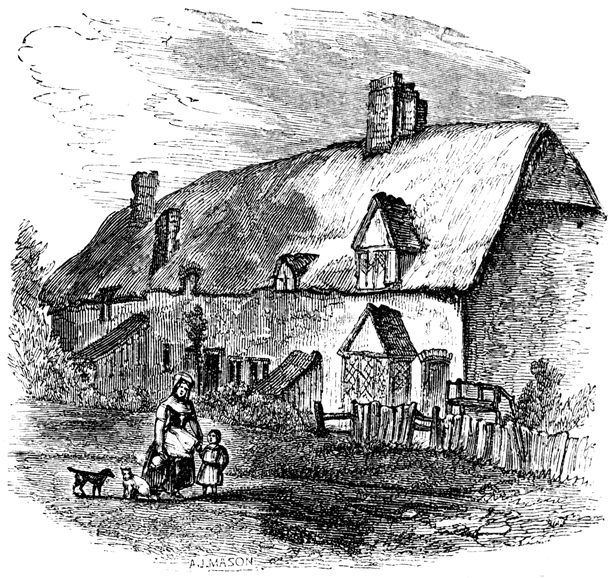
MOTHER SHIPTON’S HOUSE.57
FORTUNE-TELLING.
And men still grope t’ anticipate
The cabinet designs of Fate;
Apply to wizards to foresee
What shall and what shall never be.
The cabinet designs of Fate;
Apply to wizards to foresee
What shall and what shall never be.
Hudibras, part iii. canto 3.
In accordance with the plan laid down, we proceed to the consideration of
the follies into which men have been led by their eager desire to pierce
the thick darkness of futurity. God himself, for his own wise purposes,
has more than once undrawn the impenetrable veil which shrouds those awful
secrets; and, for purposes just as wise, he has decreed that, except in
these instances, ignorance shall be our lot for ever. It is happy for man
that he does not know what the morrow is to bring forth; but, unaware of
this great blessing, he has, in all ages of the world, presumptuously
endeavoured to trace the events of unborn centuries, and anticipate the
march of time. He has reduced this presumption into a study. He has
divided it into sciences and systems without number, employing his whole
life in the vain pursuit. Upon no subject has it been so easy to deceive
the world as upon this. In every breast the curiosity exists in a greater
or less degree, and can only be conquered by a long course of
self-examination, and a firm reliance that the future would not be hidden
from our sight, if it were right that we should be acquainted with it.
An undue opinion of our own importance in the scale of creation is at the
bottom of all our unwarrantable notions in this respect. How flattering to
the pride of man to think that the stars in their courses watch over him,
and typify, by their movements and aspects, the joys or the sorrows that
await him! He, less in proportion to the universe than the all-but
invisible insects that feed in myriads on a summer’s leaf are to this
great globe itself, fondly imagines that eternal worlds were chiefly
created to prognosticate his fate. How we should pity the arrogance of the
worm that crawls at our feet, if we knew that it also desired to know the
secrets of futurity, and imagined that meteors shot athwart the sky to
warn it that a tom-tit was hovering near to gobble it up; that storms and
earthquakes, the revolutions of empires, or the fall of mighty monarchs,
only happened to predict its birth, its progress, and its decay! Not a
whit less presuming has man shewn himself; not a whit less arrogant are
the sciences, so called, of astrology, augury, necromancy, geomancy,
palmistry, and divination of every kind.Leaving out of view the oracles of pagan antiquity and religious predictions in general, and confining ourselves solely to the persons who, in modern times, have made themselves most conspicuous in foretelling the future, we shall find that the sixteenth and seventeenth centuries were the golden age of these impostors. Many of them have been already mentioned in their character of alchymists. The union of the two pretensions is not at all surprising. It was to be expected that those who assumed a power so preposterous as that of prolonging the life of man for several centuries, should pretend, at the same time, to foretell the events which were to mark that preternatural span of existence. The world would as readily believe that they had discovered all secrets, as that they had only discovered one. The most celebrated astrologers of Europe, three centuries ago, were alchymists. Agrippa, Paracelsus, Dr. Dee, and the Rosicrucians, all laid as much stress upon their knowledge of the days to come, as upon their pretended possession of the philosopher’s stone and the elixir of life. In their time, ideas of the wonderful, the diabolical, and the supernatural, were rifer than ever they were before. The devil or the stars were universally believed to meddle constantly in the affairs of men; and both were to be consulted with proper ceremonies. Those who were of a melancholy and gloomy temperament betook themselves to necromancy and sorcery; those more cheerful and aspiring devoted themselves to astrology. The latter science was encouraged by all the monarchs and governments of that age. In England, from the time of Elizabeth to that of William and Mary, judicial astrology was in high repute. During that period flourished Drs. Dee, Lamb, and Forman; with Lilly, Booker, Gadbury, Evans, and scores of nameless impostors in every considerable town and village in the country, who made it their business to cast nativities, aid in the recovery of stolen goods, prognosticate happy or unhappy marriages, predict whether journeys would be prosperous, and note lucky moments for the commencement of any enterprise, from the setting up of a cobbler’s shop to the marching of an army. Men who, to use the words of Butler, did
“Deal in Destiny’s dark counsel,
And sage opinion of the moon sell;
To whom all people far and near
On deep importance did repair,
When brass and pewter pots did stray,
And linen slunk out of the way.”
And sage opinion of the moon sell;
To whom all people far and near
On deep importance did repair,
When brass and pewter pots did stray,
And linen slunk out of the way.”

HENRY ANDREWS, THE ORIGINAL “FRANCIS MOORE.”
After the great fire of London, which Lilly said he had foretold, he was sent for by the committee of the House of Commons appointed to inquire into the causes of the calamity. In his Monarchy or no Monarchy, published in 1651, he had inserted an hieroglyphical plate representing on one side persons in winding-sheets digging graves; and on the other a large city in flames. After the great fire, some sapient member of the legislature bethought him of Lilly’s book, and having mentioned it in the house, it was agreed that the astrologer should be summoned. Lilly attended accordingly, when Sir Robert Brook told him the reason of his summons, and called upon him to declare what he knew. This was a rare opportunity for the vainglorious Lilly to vaunt his abilities; and he began a long speech in praise of himself and his pretended science. He said that, after the execution of Charles I., he was extremely desirous to know what might from that time forth happen to the parliament and to the nation in general. He therefore consulted the stars, and satisfied himself. The result of his judgment he put into emblems and hieroglyphics, without any commentary, so that the true meaning might be concealed from the vulgar, and made manifest only to the wise; imitating in this the example of many wise philosophers who had done the like.
“Did you foresee the year of the fire?” said a member. “No,” quoth Lilly, “nor was I desirous. Of that I made no scrutiny.” After some further parley, the house found they could make nothing of the astrologer, and dismissed him with great civility.
One specimen of the explanation of a prophecy given by Lilly, and related by him with much complacency, will be sufficient to shew the sort of trash by which he imposed upon the million. “In the year 1588,” says he, “there was a prophecy printed in Greek characters, exactly deciphering the long troubles of the English nation from 1641 to 1660.” And it ended thus: “And after him shall come a dreadful dead man, and with him a royal G, of the best blood in the world; and he shall have the crown, and shall set England on the right way, and put out all heresies.” The following is the explanation of this oracular absurdity:
“Monkery being extinguished above eighty or ninety years, and the Lord General’s name being Monk, is the dead man. The royal G or C [it is gamma in the Greek, intending C in the Latin, being the third letter in the alphabet] is Charles II., who for his extraction may be said to be of the best blood of the world.”In France and Germany astrologers met even more encouragement than they received in England. In very early ages Charlemagne and his successors fulminated their wrath against them in common with sorcerers. Louis XI., that most superstitious of men, entertained great numbers of them at his court; and Catherine de Medicis, that most superstitious of women, hardly ever undertook any affair of importance without consulting them. She chiefly favoured her own countrymen; and during the time she governed France, the land was overrun by Italian conjurors, necromancers, and fortune-tellers of every kind. But the chief astrologer of that day, beyond all doubt, was the celebrated Nostradamus, physician to her husband, King Henry II. He was born in 1503 at the town of St. Remi, in Provence, where his father was a notary. He did not acquire much fame till he was past his fiftieth year, when his famous Centuries, a collection of verses, written in obscure and almost unintelligible language, began to excite attention. They were so much spoken of in 1556, that Henry II. resolved to attach so skilful a man to his service, and appointed him his physician. In a biographical notice of him, prefixed to the edition of his Vraies Centuries, published at Amsterdam in 1668, we are informed that he often discoursed with his royal master on the secrets of futurity, and received many great presents as his reward, besides his usual allowance for medical attendance. After the death of Henry he retired to his native place, where Charles IX. paid him a visit in 1564; and was so impressed with veneration for his wondrous knowledge of the things that were to be, not in France only, but in the whole world for hundreds of years to come, that he made him a counsellor of state and his own physician, besides treating him in other matters with a royal liberality. “In fine,” continues his biographer, “I should be too prolix were I to tell all the honours conferred upon him, and all the great nobles and learned men that arrived at his house from the very ends of the earth, to see and converse with him as if he had been an oracle. Many strangers, in fact, came to France for no other purpose than to consult him.”
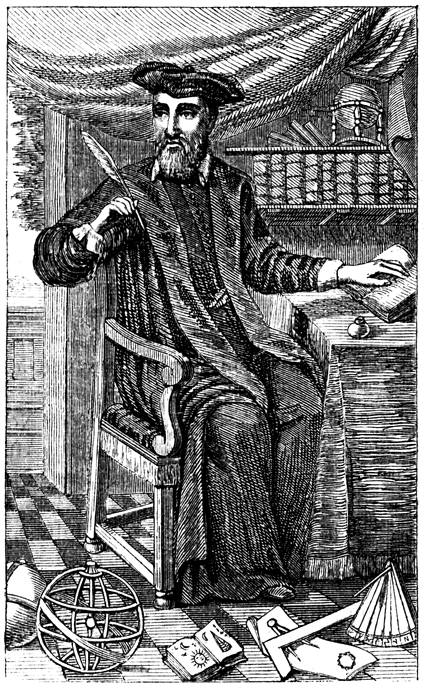
NOSTRADAMUS.—FROM THE FRONTISPIECE TO A COLLECTION OF HIS PROPHECIES, PUBLISHED AT AMSTERDAM, A.D. 1666.
He is to this day extremely popular in France and the Walloon country of Belgium, where old farmer-wives consult him with great confidence and assiduity.
Catherine di Medicis was not the only member of her illustrious house who entertained astrologers. At the beginning of the fifteenth century there was a man, named Basil, residing in Florence, who was noted over all Italy for his skill in piercing the darkness of futurity. It is said that he foretold to Cosmo di Medicis, then a private citizen, that he would attain high dignity, inasmuch as the ascendant of his nativity was adorned with the same propitious aspects as those of Augustus Cæsar and the Emperor Charles V.59 Another astrologer foretold the death of Prince Alexander di Medicis; and so very minute and particular was he in all the circumstances, that he was suspected of being chiefly instrumental in fulfilling his own prophecy—a very common resource with these fellows to keep up their credit. He foretold confidently that the prince should die by the hand of his own familiar friend, a person of a slender habit of body, a small face, a swarthy complexion, and of most remarkable taciturnity. So it afterwards happened, Alexander having been murdered in his chamber by his cousin Lorenzo, who corresponded exactly with the above description.60 The author of Hermippus Redivivus, in relating this story, inclines to the belief that the astrologer was guiltless of any participation in the crime, but was employed by some friend of Prince Alexander to warn him of his danger.
A much more remarkable story is told of an astrologer who lived in Romagna in the fifteenth century, and whose name was Antiochus Tibertus.61 At that time nearly all the petty sovereigns of Italy retained such men in their service; and Tibertus, having studied the mathematics with great success at Paris, and delivered many predictions, some of which, for guesses, were not deficient in shrewdness, was taken into the household of Pandolfo di Malatesta, the sovereign of Rimini. His reputation was so great, that his study was continually thronged either with visitors who were persons of distinction, or with clients who came to him for advice; and in a short time he acquired a considerable fortune. Notwithstanding all these advantages, he passed his life miserably, and ended it on the scaffold. The following story afterwards got into circulation, and has been often triumphantly cited by succeeding astrologers as an irrefragable proof of the truth of their science. It was said that, long before he died, he uttered three remarkable prophecies—one relating to himself, another to his friend, and the third to his patron, Pandolfo di Malatesta. The first delivered was that relating to his friend Guido di Bogni, one of the greatest captains of the time. Guido was exceedingly desirous to know his fortune, and so importuned Tibertus, that the latter consulted the stars and the lines on his palm to satisfy him. He afterwards told him with a sorrowful face, that, according to all the rules of astrology and palmistry, he should be falsely suspected by his best friend, and should lose his life in consequence. Guido then asked the astrologer if he could foretell his own fate; upon which Tibertus again consulted the stars, and found that it was decreed from all eternity that he should end his days on the scaffold. Malatesta, when he heard these predictions, so unlikely, to all present appearance, to prove true, desired his astrologer to predict his fate also, and to hide nothing from him, however unfavourable it might be. Tibertus complied, and told his patron, at that time one of the most flourishing and powerful princes of Italy, that he should suffer great want, and die at last like a beggar in the common hospital of Bologna. And so it happened in all three cases. Guido di Bogni was accused by his own father-in-law, the Count di Bentivoglio, of a treasonable design to deliver up the city of Rimini to the papal forces, and was assassinated afterwards, by order of the tyrant Malatesta, as he sat at the supper-table, to which he had been invited in all apparent friendship. The astrologer was at the same time thrown into prison, as being concerned in the treason of his friend. He attempted to escape, and had succeeded in letting himself down from his dungeon-window into a moat, when he was discovered by the sentinels. This being reported to Malatesta, he gave orders for his execution on the following morning.
Malatesta had, at this time, no remembrance of the prophecy; and his own fate gave him no uneasiness; but events were silently working its fulfilment. A conspiracy had been formed, though Guido di Bogni was innocent of it, to deliver up Rimini to the pope; and all the necessary measures having been taken, the city was seized by the Count de Valentinois. In the confusion, Malatesta had barely time to escape from his palace in disguise. He was pursued from place to place by his enemies, abandoned by all his former friends, and, finally, by his own children. He at last fell ill of a languishing disease, at Bologna; and, nobody caring to afford him shelter, he was carried to the hospital, where he died. The only thing that detracts from the interest of this remarkable story is the fact, that the prophecy was made after the event.
For some weeks before the birth of Louis XIV., an astrologer from Germany, who had been sent for by the Marshal de Bassompierre and other noblemen of the court, had taken up his residence in the palace, to be ready, at a moment’s notice, to draw the horoscope of the future sovereign of France. When the queen was taken in labour, he was ushered into a contiguous apartment, that he might receive notice of the very instant the child was born. The result of his observations were the three words, diu, durè, feliciter; meaning, that the new-born prince should live and reign long, with much labour, and with great glory. No prediction less favourable could have been expected from an astrologer, who had his bread to get, and who was at the same time a courtier. A medal was afterwards struck in commemoration of the event; upon one side of which was figured the nativity of the prince, representing him as driving the chariot of Apollo, with the inscription “Ortus solis Gallici,”—the rising of the Gallic sun.
The best excuse ever made for astrology was that offered by the great astronomer, Kepler, himself an unwilling practiser of the art.
He had many applications from his friends to cast nativities for them, and generally gave a positive refusal to such as he was not afraid of offending by his frankness. In other cases he accommodated himself to the prevailing delusion. In sending a copy of his Ephemerides to Professor Gerlach, he wrote, that they were nothing but worthless conjectures; but he was obliged to devote himself to them, or he would have starved. “Ye overwise philosophers,” he exclaimed, in his Tertius Interveniens; “ye censure this daughter of astronomy beyond her deserts! Know ye not that she must support her mother by her charms? The scanty reward of an astronomer would not provide him with bread, if men did not entertain hopes of reading the future in the heavens.”
Necromancy was, next to astrology, the pretended science most resorted to,
by those who wished to pry into the future. The earliest instance upon
record is that of the witch of Endor and the spirit of Samuel. Nearly all
the nations of antiquity believed in the possibility of summoning departed
ghosts to disclose the awful secrets that God made clear to the
disembodied. Many passages in allusion to this subject will at once
suggest themselves to the classical reader; but this art was never carried
on openly in any country. All governments looked upon it as a crime of the
deepest dye. While astrology was encouraged, and its professors courted
and rewarded, necromancers were universally condemned to the stake or the
gallows. Roger Bacon, Albertus Magnus, Arnold of Villeneuve, and many
others, were accused by the public opinion of many centuries, of meddling
in these unhallowed matters. So deep-rooted has always been the popular
delusion with respect to accusations of this kind, that no crime was ever
disproved with such toil and difficulty. That it met great encouragement,
nevertheless, is evident from the vast numbers of pretenders to it; who,
in spite of the danger, have existed in all ages and countries.
Geomancy, or the art of foretelling the future by means of lines and
circles, and other mathematical figures drawn on the earth, is still
extensively practised in Asiatic countries, but is almost unknown in
Europe.
Augury, from the flight or entrails of birds, so favourite a study among
the Romans, is, in like manner, exploded in Europe. Its most assiduous
professors, at the present day, are the abominable Thugs of India.
Divination, of which there are many kinds, boasts a more enduring
reputation. It has held an empire over the minds of men from the earliest
periods of recorded history, and is, in all probability, coeval with time
itself. It was practised alike by the Jews, the Egyptians, the Chaldeans,
the Persians, the Greeks, and the Romans; is equally known to all modern
nations, in every part of the world; and is not unfamiliar to the
untutored tribes that roam in the wilds of Africa and America. Divination,
as practised in civilised Europe at the present day, is chiefly from
cards, the tea-cup, and the lines on the palm of the hand. Gipsies alone
make a profession of it; but there are thousands and tens of thousands of
humble families in which the good-wife, and even the good-man, resort to
the grounds at the bottom of their tea-cups, to know whether the next
harvest will be abundant, or their sow bring forth a numerous litter; and
in which the young maidens look to the same place to know when they are to
be married, and whether the man of their choice is to be dark or fair,
rich or poor, kind or cruel. Divination by cards, so great a favourite
among the moderns, is, of course, a modern science; as cards do not yet
boast an antiquity of much more than four hundred years. Divination by the
palm, so confidently believed in by half the village lasses in Europe, is
of older date, and seems to have been known to the Egyptians in the time
of the patriarchs; as well as divination by the cup, which, as we are
informed in Genesis, was practised by Joseph. Divination by the rod was
also practised by the Egyptians. In comparatively recent times, it was
pretended that by this means hidden treasures could be discovered. It now
appears to be altogether exploded in Europe. Onomancy, or the foretelling
a man’s fate by the letters of his name, and the various transpositions of
which they are capable, is a more modern sort of divination; but it
reckons comparatively few believers.
Subscriure's a:
Comentaris (Atom)